

Writing lived-in travel guides from long stays and real routes
Ready to explore Wadi Shab Oman travel guide, one of the most thrilling and beautiful adventures in Oman?
This spectacular valley, carved by a ribbon of turquoise water and framed by dramatic cliffs, is home to one of the most beautiful hikes we have done anywhere. And not just because the scenery is absurdly good. Few places can brag about a route that begins on dry land and ends with you wading, swimming, and quite literally slipping into the landscape.
That is part of what makes Wadi Shab so special. One stretch is a scenic hike through the canyon, another takes you straight through the water, and the grand finale? A swim through a narrow crack in the rocks that leads to a hidden waterfall tucked inside a cave. Yes, it is every bit as magical as it sounds.
Before we went, we had plenty of questions ourselves, from what to wear and how difficult the trail really is to whether the swim is worth it. So in this guide, we are sharing everything we learned, all the practical tips we wish we had before going, and exactly what to expect from the experience.
More Oman Travel Guides
These guides will help you plan the sights, the route, and important tips.
Table of Contents
Basic information about Wadi Ash Shab
Total distance: 2.5 kilometers (linear). 5 kilometers total.
Total visit duration: approximately 3 hours to complete the route and enjoy the pools.
Elevation gain: 85 meters (it is practically flat, with a few uneven steps in some sections).
Difficulty: easy to moderate (especially the swimming section and reaching the final waterfall).
Facilities: at the start of the route there are restrooms, a bar, and a rental stand for life jackets and water shoes. Once on the route, there are no services or supervision.
How to get to Wadi Ash Shab

Wadi Shab is a 5-minute drive from the small town of Tiwi.
We chose to stay at the Tiwi Pearl House so we could start our trek bright and early the next day. The hotel isn’t luxurious, but it was clean and well-maintained, and it’s truly one of the best you can find in the area.
You can see our complete 10-day Oman itinerary in this post .
Once at the wadi, there’s free parking where you can leave your car for the duration of the excursion.
It’s possible to visit Wadi Shab from Muscat, but you’ll have to drive about 150 kilometers. In this case, we would recommend visiting the wadi in the late afternoon, as it’s most crowded around mid-morning.
Finally, if you prefer to visit Wadi Shab on a guided tour, here are some of the best options:
– Wadi Ash Shab and Bimman Sinkhole Tour from Muscat
– Wadi Ash Shab Tour from Muscat
When to visit Wadi Shab
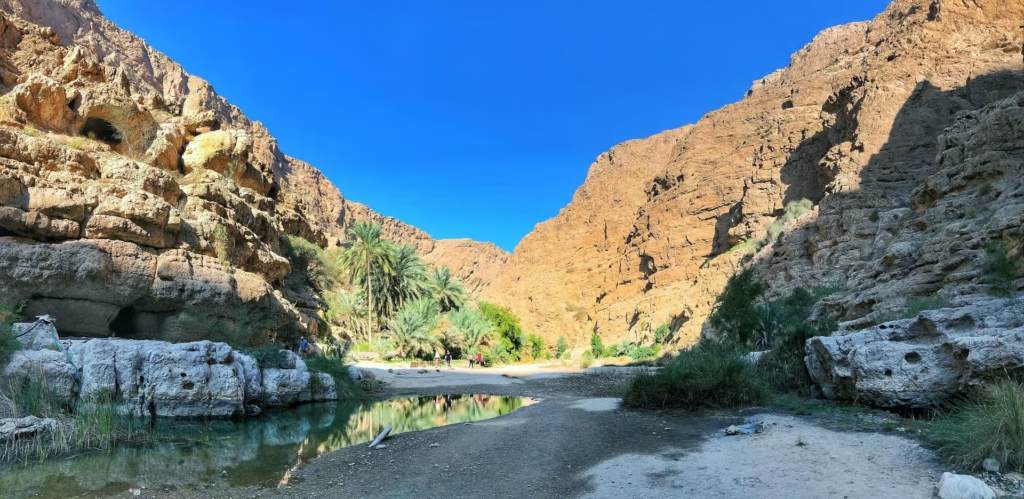
Any time of year is good for visiting Wadi Shab , as even in the hottest summer months, the wadi offers shade and refreshing water.
The most important thing is to plan your visit after several days without rain , as after heavy rainfall the water level can rise and swimming can be dangerous. Also, after rain, the water will be much less clear than usual.
The best time to visit is early in the morning , when the heat is less intense and the crowds and guided tours haven’t yet arrived.
Another option is to go late in the afternoon, but in that case, you’ll have to be careful not to miss the last boat of the day. We’ll tell you more about this later.
We visited Wadi Shab in February, starting our visit at 7:30 in the morning, and we were practically alone on the way there.
On the way back, we encountered many groups starting their hike, and the parking lot was packed.
We went on a Saturday, and although they say the weekend (Friday and Saturday in Oman) is the busiest time, if you go early you won’t have this problem.
So, it’s definitely worth getting up early! Having this place all to yourselves will be an unforgettable experience.
What to bring to Wadi Shab and how to dress
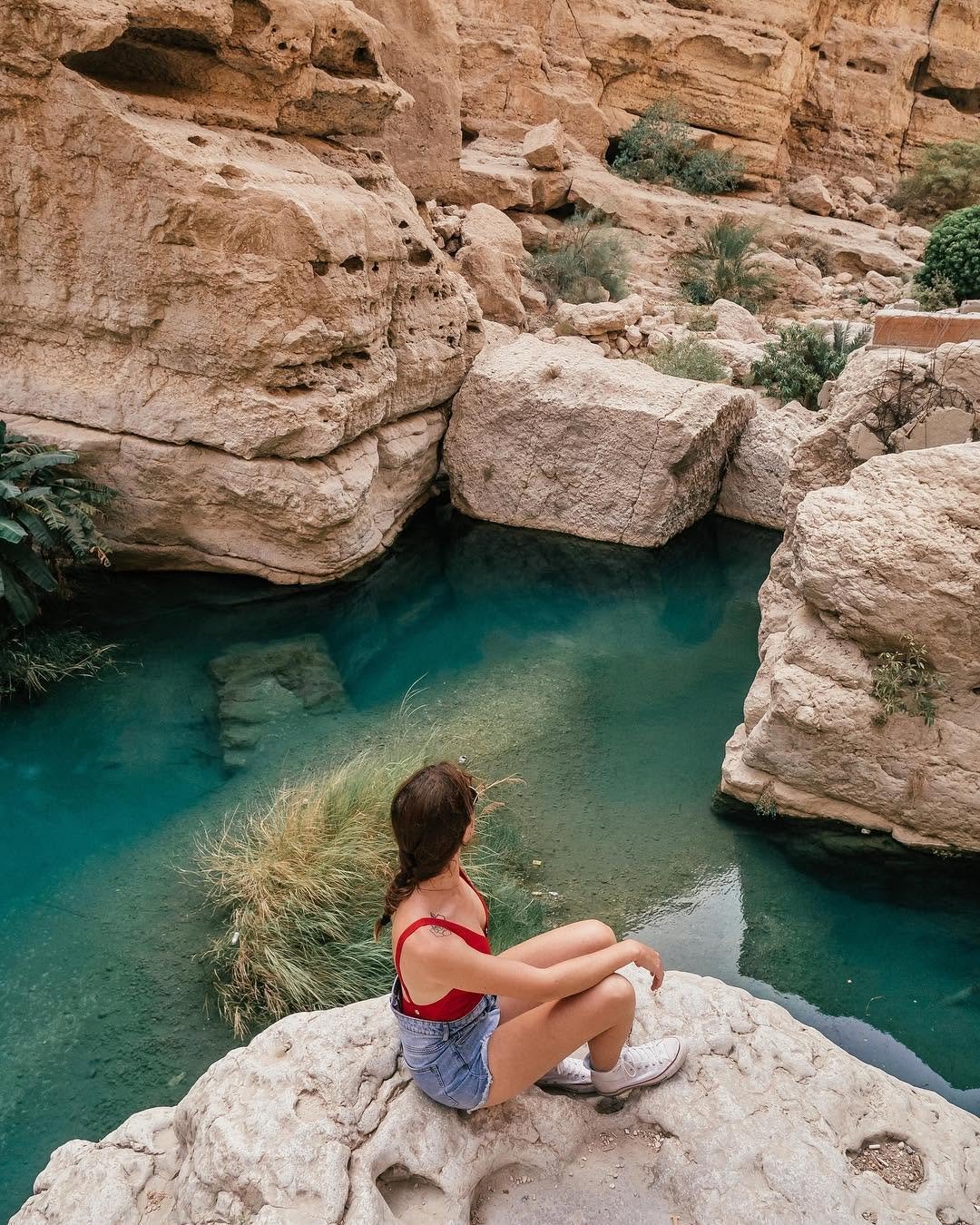
Here’s a list of essentials to bring to Wadi Ash Shab:
– On you: swimsuit, shorts, t-shirt, hat, sunglasses, and trekking shoes
– In a backpack: water shoes, sunscreen, water, snacks, and a light towel
– In a waterproof case: phone (if you want to take photos), wallet, and car keys.
It’s important to respect Omani culture , so we advise you to always wear shorts (or leggings) and a t-shirt when swimming. This is especially important for women.
Before starting the swimming portion of the route, you can leave everything except your waterproof bag on a small beach. No one will take anything from you, don’t worry.
We left our trekking boots and backpack on the beach, like many other visitors, and everything was fine.
Detailed and complete route to visit Wadi Shab
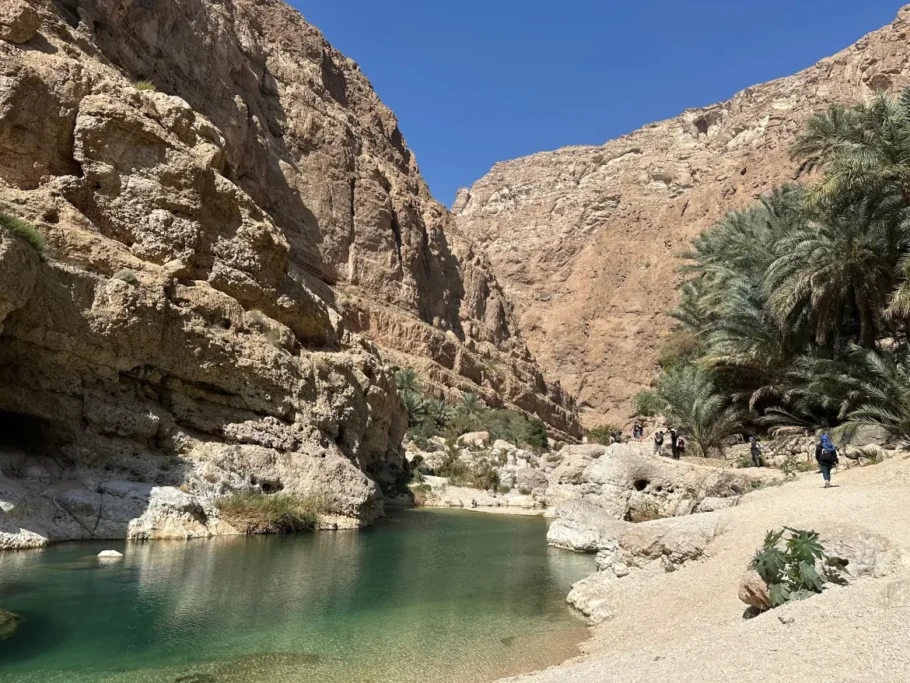
Now we’ll tell you step by step what the Wadi Shab route consists of and what to expect at each stage
1. Boat trip to the start of the route
After leaving the car in the parking lot and a quick stop at the restroom, we boarded the boat that took us to the other side of the river , where the trail begins.
The round trip costs 1 OMR per person and is payable in cash on the way there. Boats depart from early morning (6:30 or 7:00 AM) until 5:30 or 6:00 PM. Return times vary depending on the time of year, so ask on the way there to be sure.
The boat ride lasts about 5 minutes and is mandatory, as there is no other way to reach the trailhead.
2. Walk to the first pool where you can swim
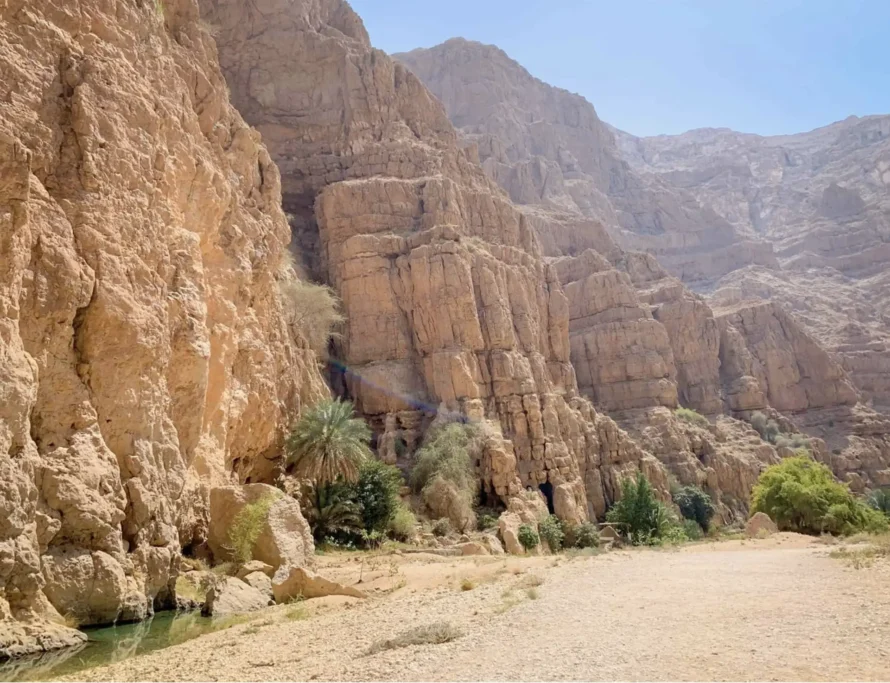
The fun begins. The first kilometer of the hike winds through palm groves , past local farms, and towering stone walls that overlook a turquoise river, sometimes flowing, sometimes dry.
Swimming is not allowed in the areas with water, as it is usually stagnant and unsafe.
Afterward, the terrain becomes a bit more uneven, with large stones, but it’s not particularly difficult. The path is usually marked with arrows on the stones, but it’s easy to stray.
Don’t worry, you’ll quickly realize your mistake and get back on track.
A couple of times, you’ll have to cross the river by stepping on some slightly slippery stones, but with good hiking boots, it’s no problem.
This is a super photogenic part of the route, so you’ll want to stop and take a thousand pictures.
At kilometer 2, we walk along an old irrigation channel ( falaj) until we see a huge, pyramid-shaped mountain. A few meters further on, we find the small beach where we can leave our things and start swimming.
3. We swam across 3 swimming pools
We swapped our boots for water shoes, left our belongings in the shade of a rock, and plunged into the cool water for the first time . What a treat!
It’s February, but the heat is already intense, so this first dip was very welcome.
Depending on the water level, you can walk through the first part of this pool, with the water up to your chest. Then you just swim. It’s very pleasant, as there are no currents and the scenery is incredible.
The second pool is a bit more uneven, with shallower and deeper areas, so swim with caution.
Before reaching the last pool, there are a series of very slippery waterfalls where you’ll be very glad you brought water shoes. An ideal spot for taking photos.
4. The secret cave
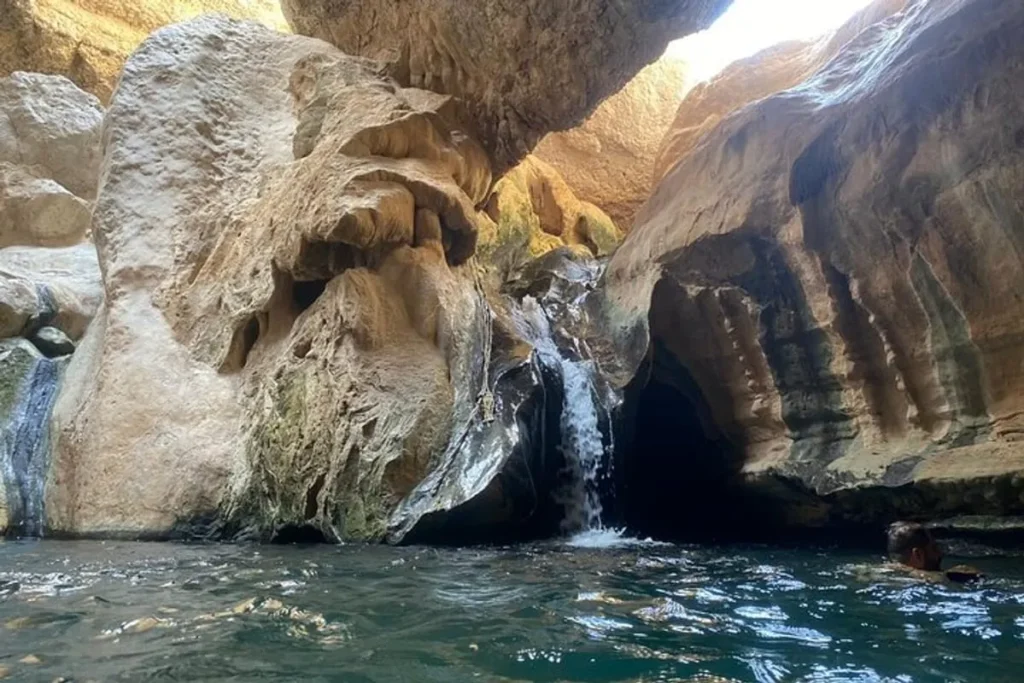
Now comes the most exciting part of the route.
We enter the last pool, which also offers the opportunity to jump into the water from the canyon walls , as it’s quite deep. A fantastic experience for the more adventurous.
But the best part is beyond a narrow passage that we must swim through with the walls just inches from our heads. Perhaps not suitable for the claustrophobic, but don’t worry, it doesn’t last long. And at the end of the passage, a secret cave
opens up before us with walls that reach a small open vault from which a powerful waterfall cascades. Incredible! Next to the waterfall, there’s a rope to climb it and jump into the water from the wall. It’s also possible to swim to another mini-cave right below the waterfall, but only for the most daring. There’s little support in this area, so if you don’t feel secure floating or holding onto the walls, we recommend bringing a life jacket or pool noodle to help you float.
5. The way back
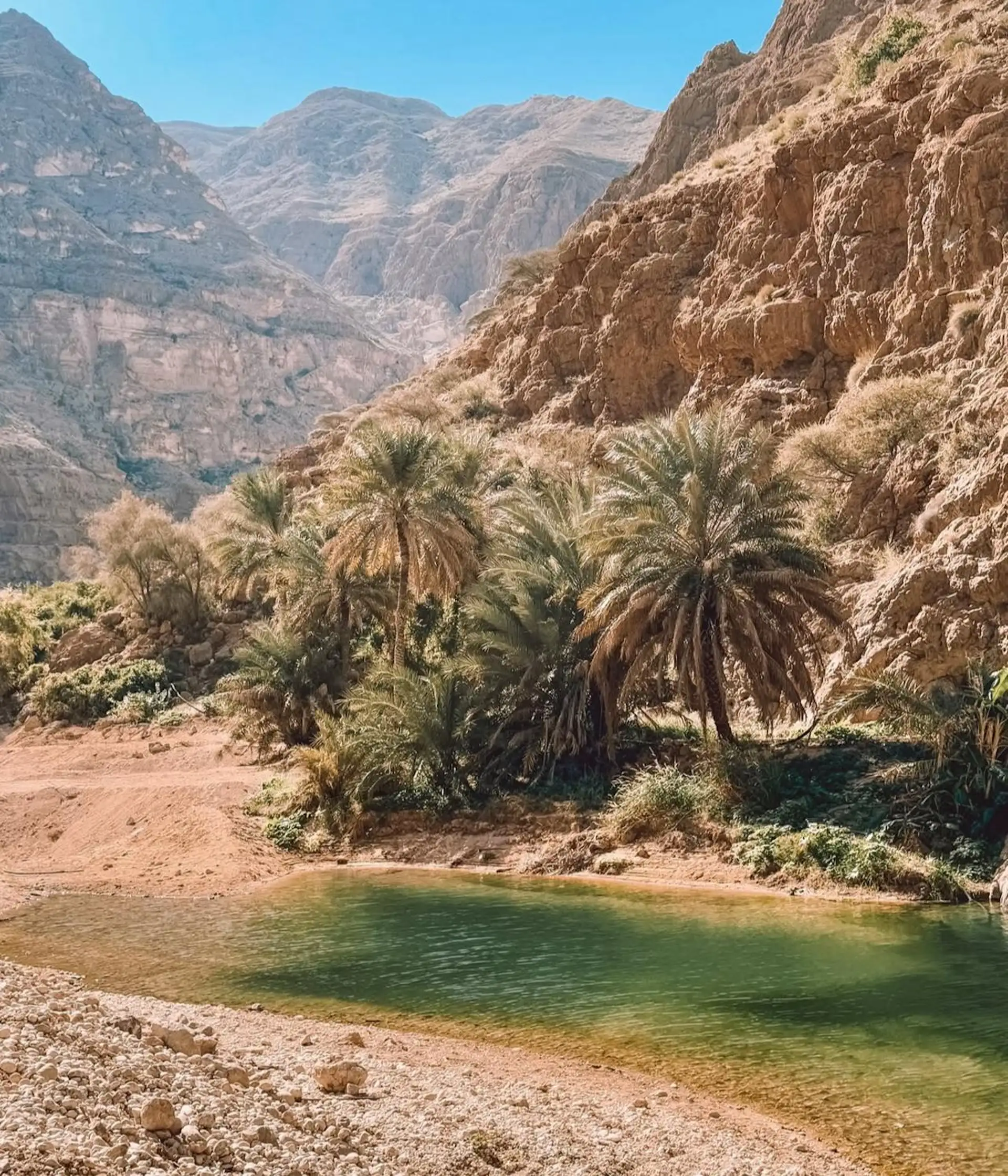
Since the route is completely linear, the return journey involves retracing our steps, this time encountering many more visitors than on the way out.
We gather our belongings, dry off, and change back into our hiking boots from our water shoes.
You’ll be glad you wore your wet clothes for the final stretch, as the sun is strong. We enjoy this incredible landscape one last time before taking the small boat back to our car.
A fantastic experience!
Other tips for visiting Wadi Shab independently
Photos in Wadi Shab:
You can carry your phone in a waterproof backpack or phone case. It’s best to use a good quality one, as it will need to float in the water since you’ll need both hands to swim.
You can also bring an action camera like a GoPro with a good mount that leaves your hands free.
We absolutely do not recommend bringing a large camera on this route.
Life jacket, float, or pool noodle rental:
If you’re not a strong swimmer or don’t fancy having to swim for several meters without being able to touch the bottom, we advise you to bring or rent a life jacket, float, or pool noodle.
We saw several older people using this technique, and they seemed very comfortable. So, no one will look at you strangely.
Caution: This is not a supervised route.
Unlike other similar routes such as Wadi Mujib in Jordan, where there are lifeguards and route managers every few meters, there is no one in Wadi Shab.
So it’s important to go with someone, be very careful, and follow safety recommendations at all times.
If you need help at any point, don’t hesitate to ask. The great thing about a popular route like Wadi Shab is that there will always be someone nearby willing to help.
That concludes our guide to visiting Wadi Shab ! One of the most spectacular places we visited during our 10-day trip to Oman .
- 5 Best Wadis In Oman (2026)
- Wadi Shab Oman Travel Guide (2026):When To Visit, Complete Route & Tips
- How to Dress in Oman as a Tourist (2026): A Minimalist Guide

- 10 Days in Oman Itinerary (2026): The most complete and original route
- What To See In Oman: 8 Most Beautiful Natural Sites (2026)