
Travel writing based on first-hand experience
This list of the best places to visit in Cairo will help you explore and fully experience this bustling and essential city, Egypt’s capital. With over 20 million residents and notoriously chaotic traffic, Cairo is the type of city that can overwhelm you at first glance. Yet, as you wander its lively streets, discover its hidden gems, and meet its warm-hearted locals, it slowly captures your heart and draws you in, leaving you unexpectedly enchanted.
More Cairo & Egypt Guides You’ll Want Before You Go
➡️Planning your route through the Egyptian capital? Pair these highlights with our detailed 3 days in Cairo itinerary, discover a few lesser-known corners in our guide to hidden gems in Cairo, and figure out where to stay in Cairo before the city sweeps you into its glorious chaos.
➡️Once the sightseeing is done, it would be deeply irresponsible not to think about food. Have a look at where to eat in Cairo, browse our guide to shopping in Cairo, or plan a slower day out with this family-focused guide to Cairo with kids.
➡️If Cairo is just one stop on a bigger adventure, these practical reads will help: our essential Egypt travel tips, this well-paced 8 days in Egypt itinerary, and the more complete 14 days in Egypt itinerary for seeing a lot more than just the big hitters.
Table of Contents
1. Citadel of Saladin
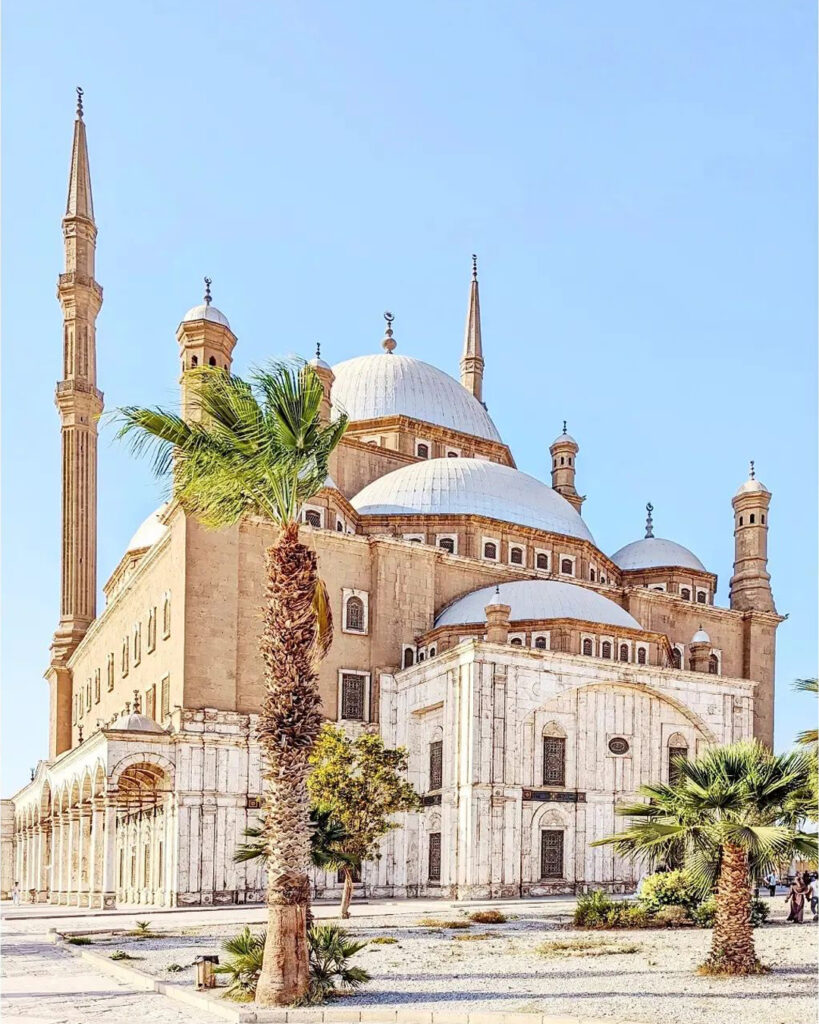
We start with Cairo’s ultimate “zoom out” button: the Citadel of Saladin, perched up on Mokattam Hill like it’s supervising the whole city (because it kind of is). This is one of the best viewpoints in Cairo and an absolute must—an ancient fortress of thick walls and hefty towers built in 1176 on Saladin’s orders to protect the city from Crusader armies. And once you’re inside? It’s basically a mini world of landmarks. You’ve got the al-Nasir Mosque with its tiled minarets, the Ottoman-style Gawhara Palace, the Tomb of Mohammed Ali, the Well of Yusuf, and the headline act: the Mosque of Muhammad Ali, aka the Alabaster Mosque (built 1830–1848), designed with the Hagia Sophia mosque in Istanbul in mind. Go inside—seriously. Dress appropriately, take your shoes off, and sit for a moment under that immense central vault with its mosaics and precious details. The street chaos fades, your brain stops buzzing, and for a minute Cairo feels… quiet. (Yes, it happens. Briefly. Enjoy it.)
Opening hours: daily from 8 am to 5 pm. Closing one hour earlier in winter.
2. Khan el-Khalili Bazaar
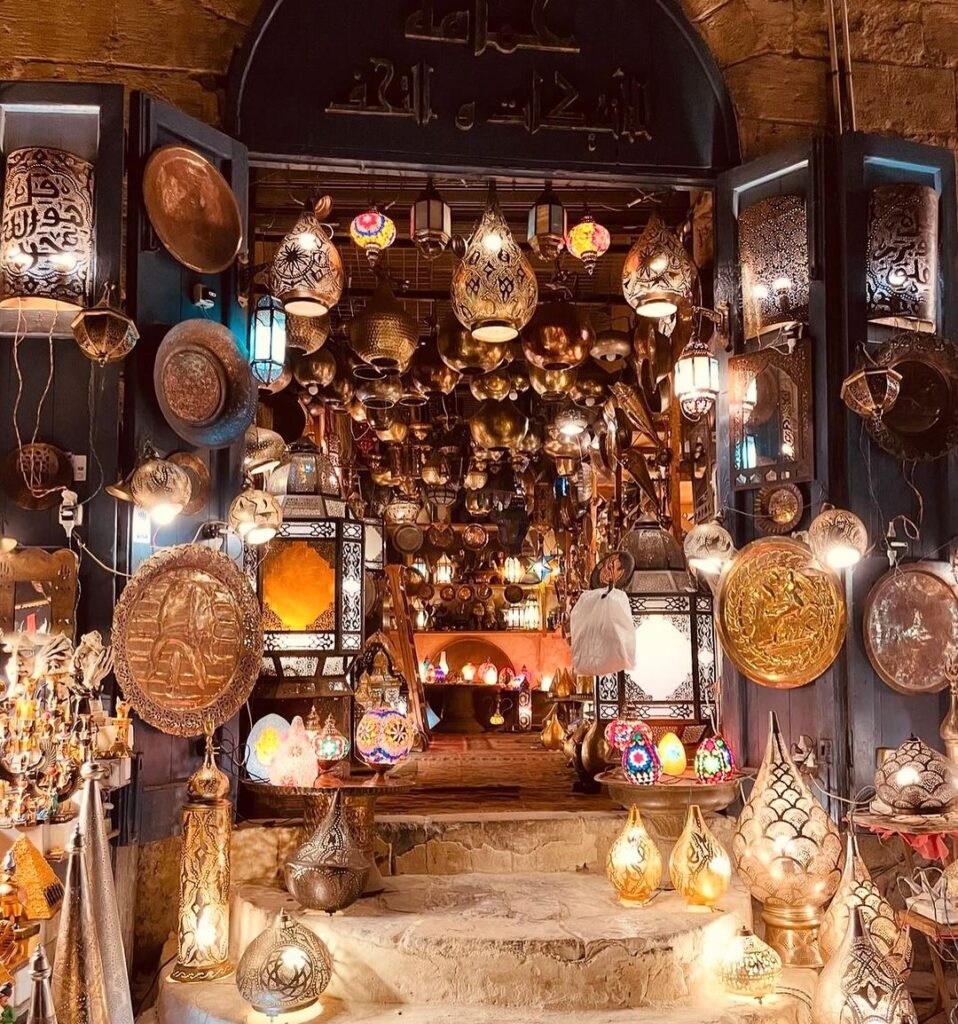
Khan el-Khalili is Cairo in full sensory overload mode—in the best way, if you like your travel experiences loud, shiny, and slightly chaotic. It started back in 1382 as a caravanserai (a rest stop for merchant caravans), and over time it ballooned into a market with nearly 1,000 shops. Translation: you can find basically anything here. The bazaar is also organized in that wonderfully old-school way where certain lanes specialize—think spice alley, jewellery alley, and whole stretches selling the same type of treasure in ten variations (and in ten price ranges, depending on your bargaining courage).
As we walk it, don’t miss streets like Sikka Khan el-Khalili and Badestan, where the old caravanserai soul still peeks through. And yes, you should absolutely stop at the legendary Fishawy café, which has been open for over 200 years without interruption—because some rituals deserve respect. Once you’ve ticked off the key spots, do yourself a favor: put the map away and wander. Let the labyrinth do its thing while you hear the constant haggling ping-ponging between merchants and tourists. To reach the bazaar, we recommend approaching via Al-Muizz, a one-kilometer pedestrian street packed with mosques and monuments—basically the most scenic “walk-in” you could ask for.
3. Pyramids of Giza
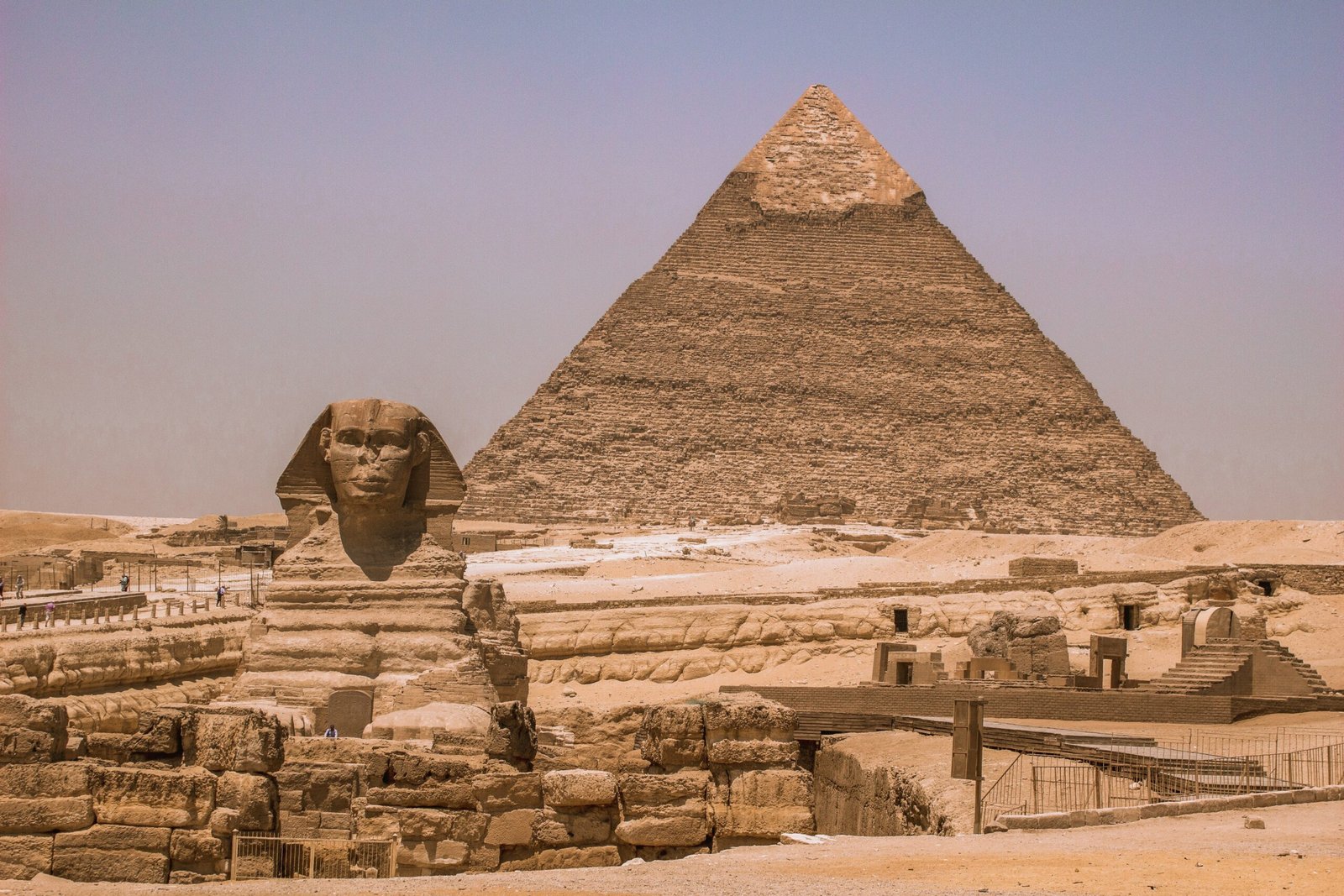
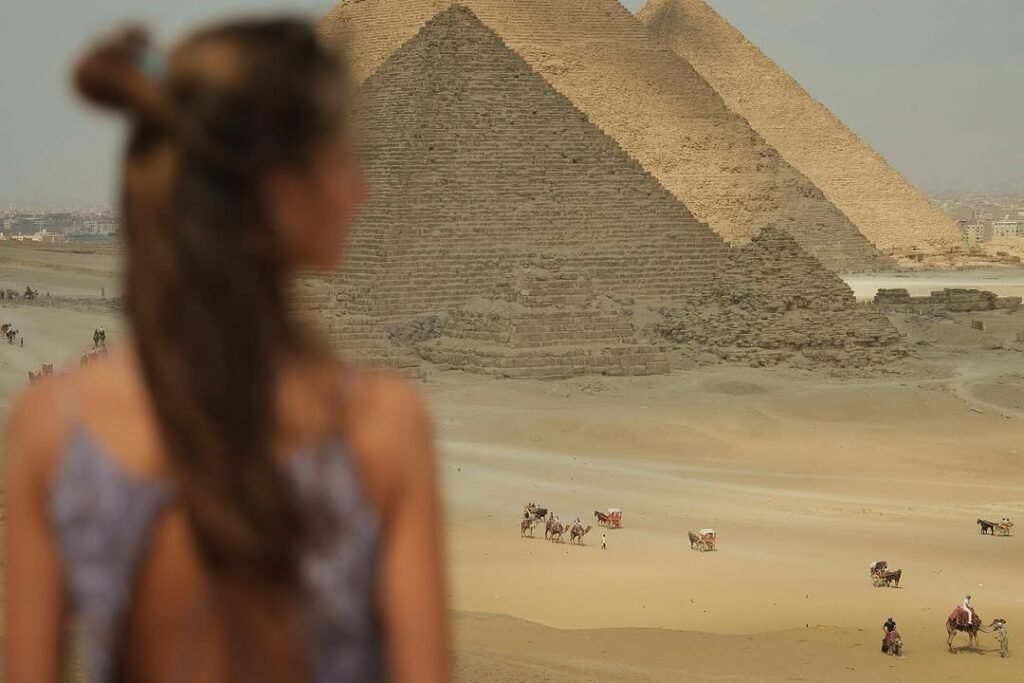
Okay. The Pyramids of Giza. The “pinch us, we’re really here” moment. Built around 2500 BC, this Ancient World wonder is made up of three monumental pyramids—tombs of the pharaohs Cheops, Chephren, and Mycerinus—and yes, they’re the kind of sight that makes you go weirdly quiet for a second. Ancient Egyptians believed these structures, catching and reflecting rays of light, helped the pharaohs achieve eternity and join the gods in the afterlife. Dramatic? Absolutely. Effective? Still standing, aren’t they?
If you’re up for it, go inside the Pyramid of Cheops. It’s not for claustrophobia sufferers (tight passages, low ceilings, lots of “why did I do this?” thoughts), but you’ll reach the burial chamber and see the sarcophagus. Nearby, you can also visit the museum housing the Solar Boat, preserved in astonishing condition. And don’t skip the Sphinx near Chephren’s pyramid—about 20 meters high, iconic profile, and a permanent “I’ve seen everything” expression.
You can reach the pyramids from Cairo by taxi, Uber, or bus. Whatever you choose, go early—really early—unless your dream is to share your once-in-a-lifetime moment with a busload of organized tour groups and a hundred selfie sticks.
Visiting hours: daily from 8 am to 5 pm.
4. Egyptian Museum
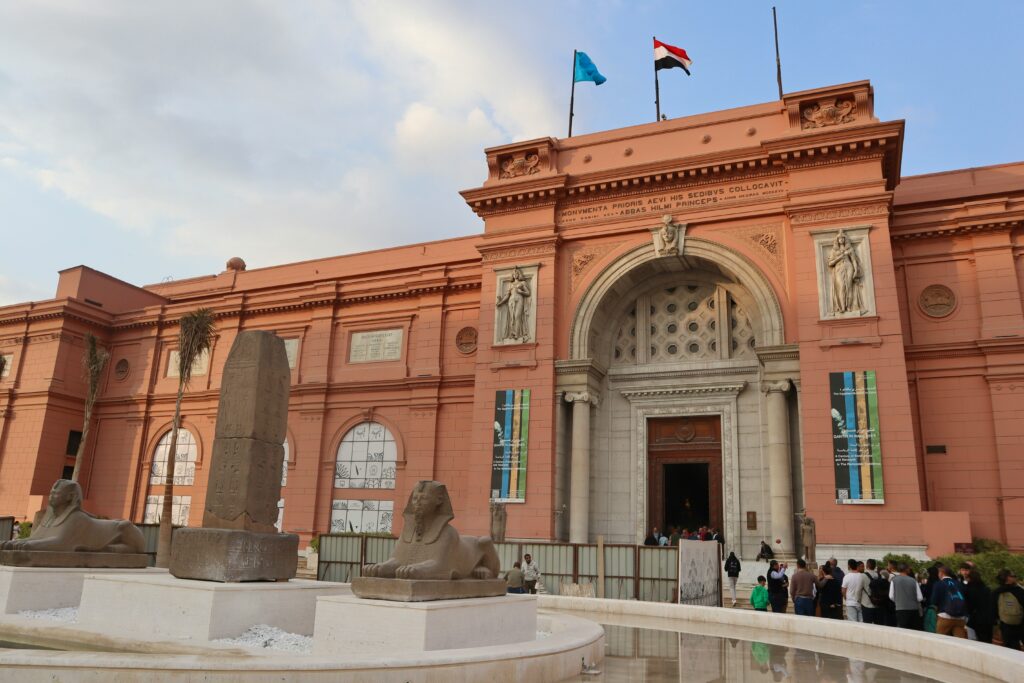
Next, we head to Tahrir Square for one of Cairo’s biggest heavy-hitters: the Egyptian Museum. This place holds the largest collection of Ancient Egyptian artifacts anywhere, and even if you think you’re “not a museum person,” Cairo will change your mind. The building opened in 1902 to protect the country’s treasures, but everything shifted in 1922 when Tutankhamun’s 3,500-piece treasure arrived—suddenly it became one of Egypt’s most visited sites. Over the years, the collection kept growing as stolen and plundered pieces were recovered from wars, foreign museums, and private collections.
Yes, you’ll come for the famous golden mask, but don’t stop there. Look out for the Seated Scribe, statues of Zoser and Akenaton, the Palette of Narmer, and the Triad of Mycerinus. And a quick “worth knowing”: the royal mummies (18 kings and 4 queens) were moved in April 2021 in a big parade to the National Museum of Egyptian Civilization—so if mummies are high on your list, that museum is now a must.
Visiting hours: Monday to Wednesday from 9 a.m. to 7 p.m., Thursdays and Sundays it closes at 9 p.m. and Fridays at 4 p.m.
5. Hanging Church
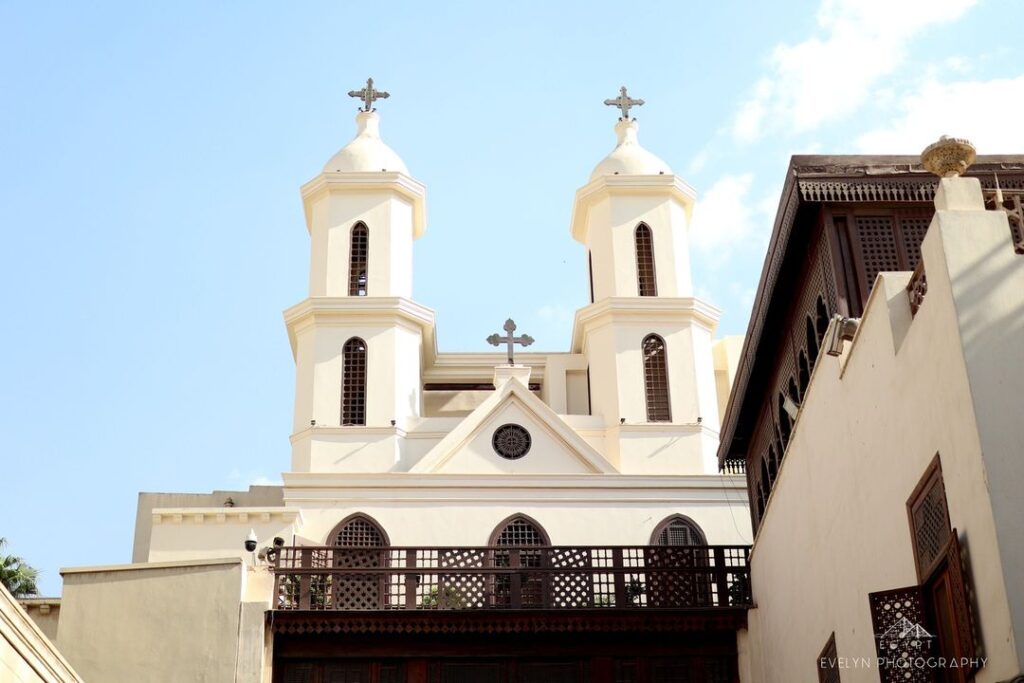
We then slip into Old Cairo for one of the city’s quiet marvels: the Hanging Church (officially, the Church of the Holy Virgin Mary). It’s among the oldest churches in Egypt and genuinely feels like a hidden gem once you step away from the traffic noise. Built in the 3rd century AD on one of the towers of the Roman-era Babylon Fortress, it’s called “hanging” because it’s literally elevated above the ground. The building has lived a complicated life—at one point it even functioned as a mosque—before returning to the Coptic Christian community as their most important sanctuary. Go inside for the marble main altar and the 13 pillars representing Jesus and the apostles. It’s beautiful, symbolic, and unexpectedly calming.
Visiting hours: daily from 8 am to 5 pm.
6. Coptic Quarter
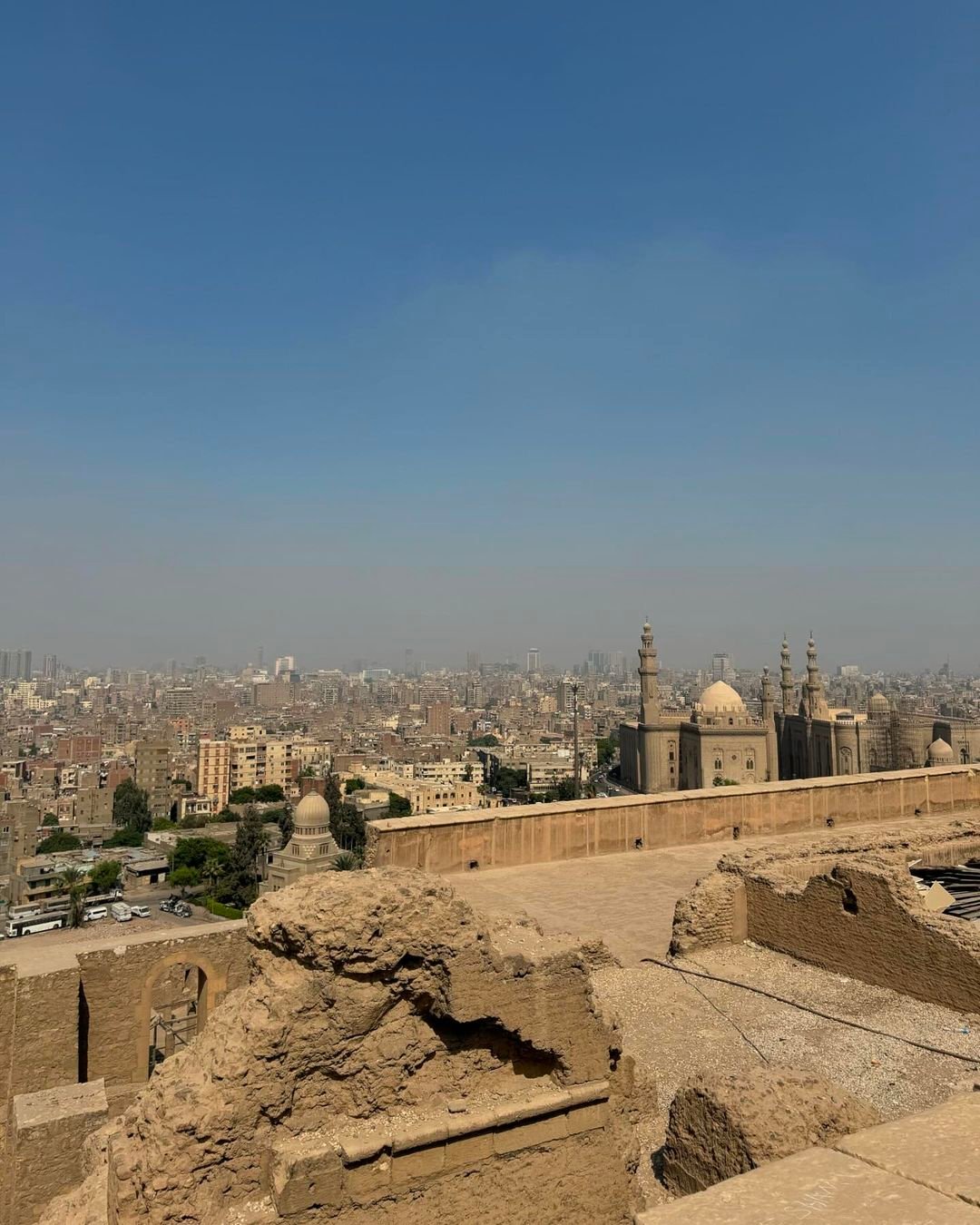
Walking the Coptic Quarter is one of our favorite Cairo moves, because it’s history you can actually feel under your feet. This is one of the city’s oldest areas and home to a large part of Cairo’s Egyptian Christian community. The Copts have deep roots here—tradition places the Holy Family in this area during their exile in Egypt, before the Arab conquest reshaped the country. As you wander, you’ll notice how Christian and Jewish history intertwine, with Byzantine and Arab influences showing up in details across buildings and courtyards.
Highlights come thick and fast: Babylon Fortress, the Coptic Museum (hello, Nag Hammadi Scrolls), the Church of Saints Sergius and Bacchus (linked to the Holy Family refuge tradition), the Hanging Church again, the Ben Ezra Synagogue (where the basket containing baby Moses is said to have been found), and the Church of St. George and St. Barbara. It’s a lot—pace yourself, sip water, and let it sink in.
7. Al-Azhar Mosque
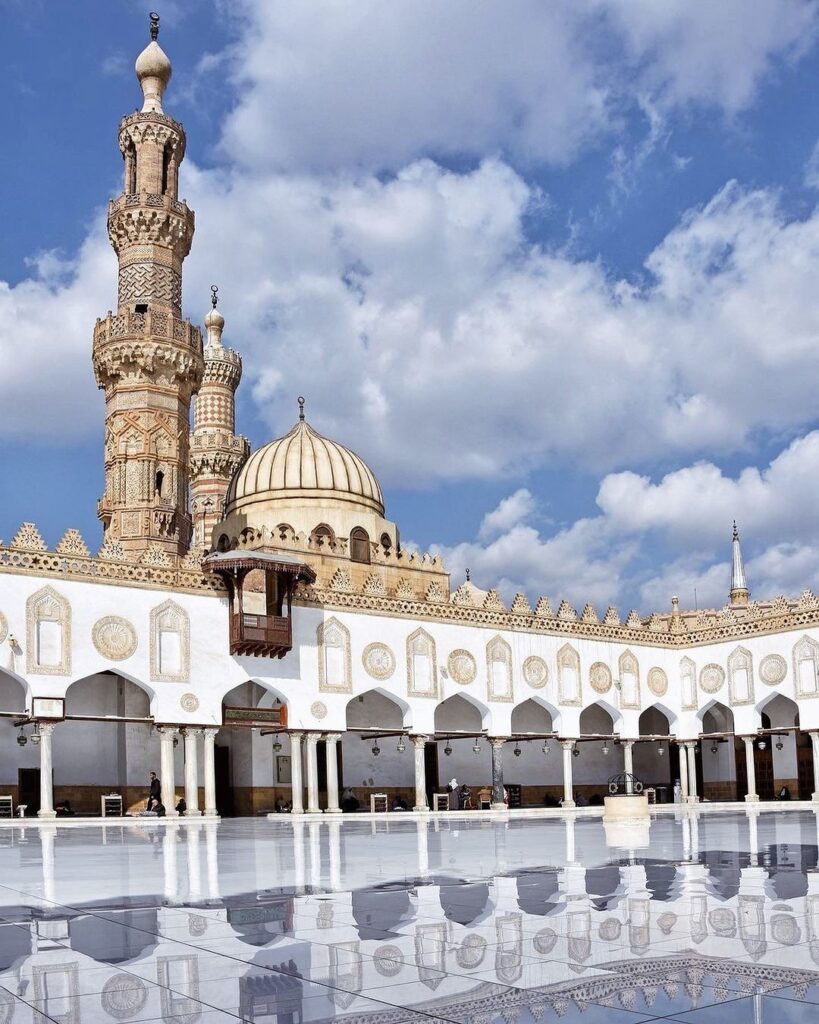
Al-Azhar Mosque is one of those places where you realize Cairo isn’t just ancient—it’s continuously influential. Built between 970 and 972 in the historic center, it has functioned for centuries as both a mosque and a university, remaining a major center for Islamic studies to this day. Its influence goes beyond religion into social, political, and legal life, shaping scholarship and decisions that echo across the wider Islamic world.
Inside, you’ll see the bright white marble courtyard, madrasa study rooms, the prayer hall, and the library. And since we’re already in the neighborhood, don’t miss the nearby Wikala caravanserai of al-Ghouri—a spectacular five-story caravanserai that’s absolutely worth the detour.
Visiting hours: daily from 9 am to 11 am and from 3 pm to 5 pm.
8. Cairo Tower
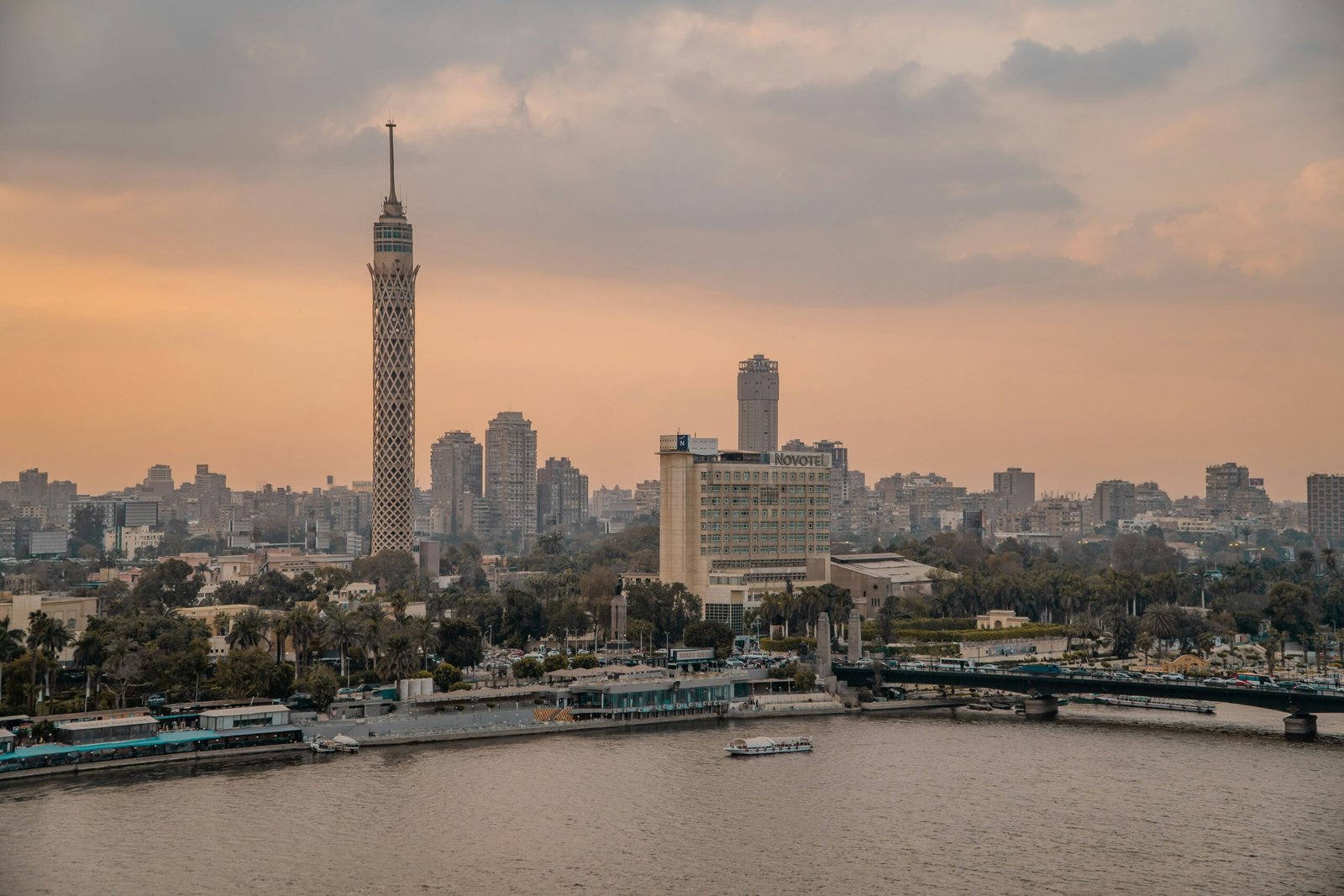
If Cairo feels endless at street level (it does), the fix is simple: go up. On a clear, fog-free day, the 186-meter Cairo Tower lets you actually understand the city’s scale—roads, rooftops, minarets, and the Nile threading it all together. The tower sits in Zamalek on Gezira Island and even has a revolving restaurant for lunch, but we’re honestly here for the open-air viewing platform. There’s something satisfying about watching the city roar from a safe distance, like you’ve stepped outside the noise for a minute.
9. City of the Dead
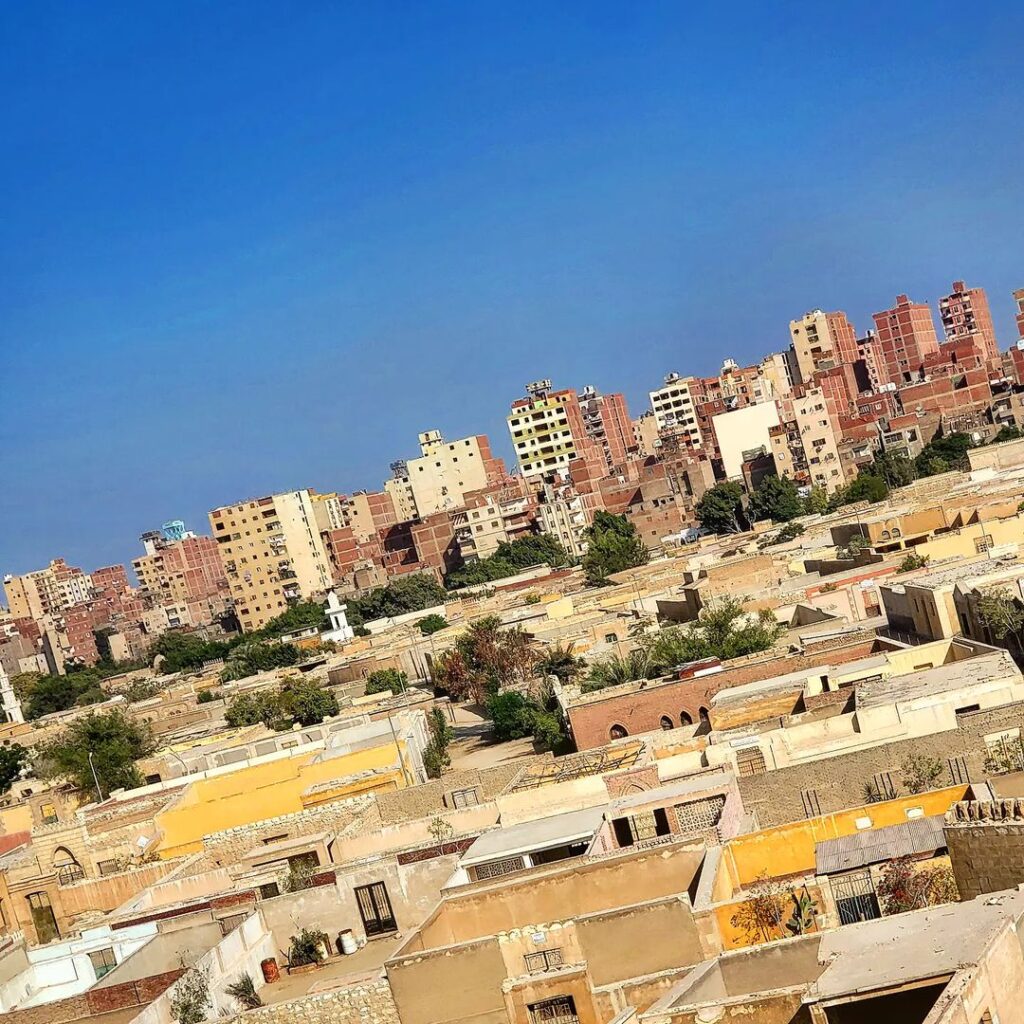
Now for the complicated one: the City of the Dead. It’s often described as one of Cairo’s most surprising places, because it’s an area where the living and the dead coexist in the same sprawling necropolis. Located behind the Citadel beneath the Mokattam Hills, this ancient Arab cemetery has, over time, become a place where people live—some by choice to remain close to ancestors, but many due to economic pressure and displacement driven by development and real estate speculation.
You’ll see modest homes where tombs share space with daily life, and you’ll also see extreme poverty. Because of that, it’s essential to go with a trusted driver or guide if you go at all. And here’s where we land: although it’s on many tourist itineraries, we have mixed feelings. Given the realities for people living there, we don’t love treating it as a “sight.” If you decide to visit, do it with sensitivity, avoid intrusive photos, and remember this is a living community, not a backdrop.
10. Mosque of Ibn Tulun
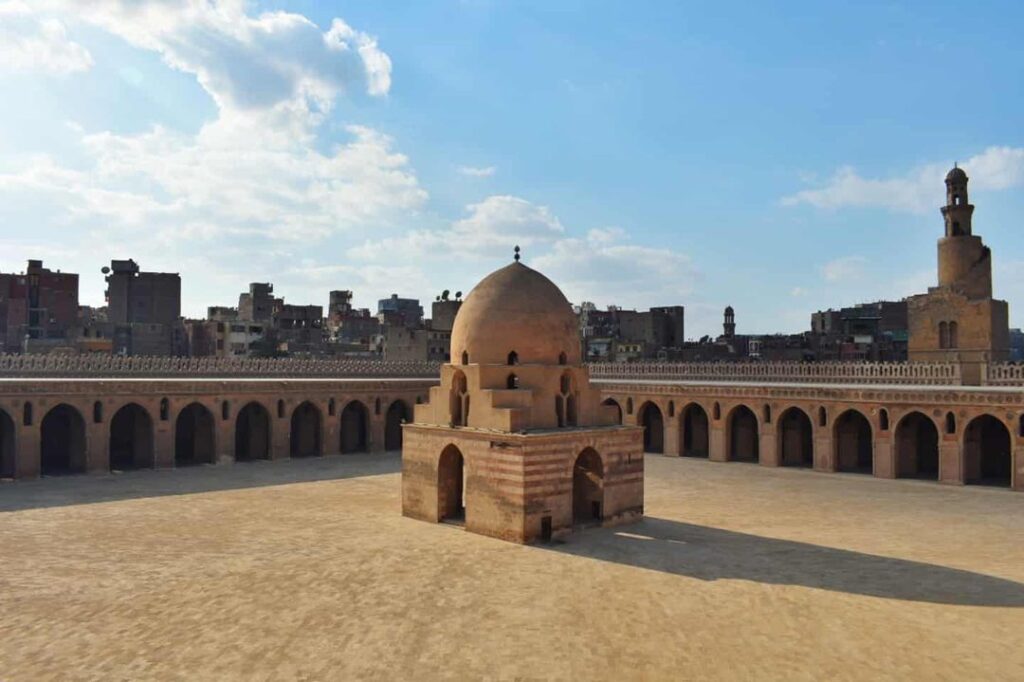
The Mosque of Ahmad Ibn Tulun is the kind of place that makes you fall a little in love with Cairo’s architecture. It’s the oldest mosque in Cairo and also the best preserved in its original form. Built between 876 and 879 from mud bricks, it has a sober, almost minimalist power to it—arches, domes, and a distinctly oriental rhythm that feels both grand and grounding. Inside, the main feature is that huge 90-square-metre courtyard, framed by arcades and centered around a fountain. It’s airy, calm, and surprisingly peaceful.
And yes, you should climb the original stepped minaret. The view at the top is one of those “Cairo goes on forever” moments—and it’s absolutely worth the stairs. (Pro tip: go earlier in the day if you want softer light and fewer people.)
11. Bab Zuweila Gate
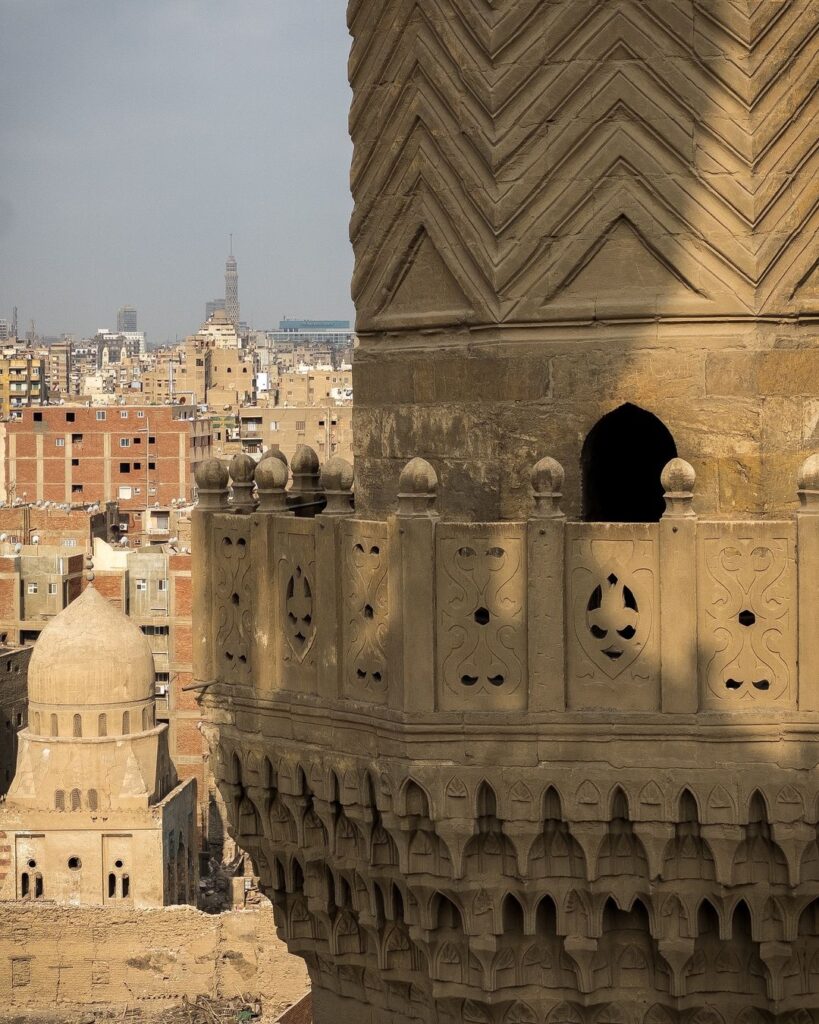
We’ll finish with a piece of Old Cairo that still feels like a guardian: Bab Zuweila, one of the three remaining gates of the medieval city walls. It was built as part of a second wall designed to better protect Cairo during the turbulent 11th and 12th centuries, and it’s packed with history. But let’s be honest—the reason you’re going to want to climb it is those two tall minarets. They were once used to spot possible invaders; today they serve a much more important purpose: they’re fantastic viewpoints over the city’s rooftops and minarets. A perfect final look before you dive back into Cairo’s beautiful chaos.
FAQs: Places to Visit in Cairo
1) What are the absolute must-see places in Cairo?
Giza Pyramids and Sphinx, Saqqara + Dahshur, the Egyptian Museum or GEM, Islamic Cairo (Citadel, Al-Azhar, Sultan Hassan), Coptic Cairo, Khan el-Khalili, Al-Muizz Street, NMEC (Royal Mummies).
2) Which museum should I pick—Egyptian Museum or the GEM?
The Tahrir museum is classic; the Grand Egyptian Museum is the new flagship—check current opening status and hours, then choose one or do both.
3) Are the pyramids “in” Cairo and how do I plan them with Saqqara/Dahshur?
They’re in greater Giza. Do Giza early, then add Saqqara’s Step Pyramid and Dahshur’s Bent/Red Pyramids for quieter, big-impact sites.
4) Is going inside a pyramid worth it?
Yes if you’re curious and okay with steep, narrow passages; buy the separate interior ticket and travel light.
5) What exactly is “Islamic Cairo”?
A historic core of mosques, madrasas, and markets—don’t miss the Citadel, Mosque of Muhammad Ali, Sultan Hassan, Al-Rifa’i, Al-Azhar, and Al-Muizz Street.
6) Is Khan el-Khalili worth a visit?
Yes—come late afternoon or evening for atmosphere; browse, haggle kindly, and pause for tea at a classic café.
7) What’s in Coptic Cairo?
The Hanging Church, Abu Serga, the Coptic Museum, and Ben Ezra Synagogue—compact, moving, and easy to pair with nearby sites.
8) Where do I see the Royal Mummies?
At the National Museum of Egyptian Civilization (NMEC) in Fustat—add the museum’s broader galleries if you have time.
9) Best viewpoints for the city?
Cairo Tower, Al-Azhar Park at sunset, Citadel terraces, and some hotel rooftops; haze clears best in cooler months.
10) How do I do a Nile felucca ride?
Head to Zamalek or Maadi docks near sunset, agree the duration and price before boarding, and bring a light layer.
11) What should I wear for mosques and sacred sites?
Modest, breathable layers; shoulders and knees covered, shoes off inside prayer halls, quiet voices and no flash.
12) How do I move between major sights?
Uber/Careem for point-to-point, metro for select hops, and a private driver to string Giza–Saqqara–Dahshur or Old Cairo circuits.
13) How many days do I need for the headline places?
Two full days hits the core; three lets you slow down, add Dahshur/NMEC, and enjoy evenings without rushing.
14) Guide or self-guided?
You can self-guide, but an Egyptologist adds depth, manages tickets, and helps with timing in heat and traffic.
15) Any photo rules I should know?
Some interiors require a paid photo permit; no drones without formal authorization; follow signs and staff guidance.
16) Family-friendly picks?
Felucca at sunset, Cairo Tower, NMEC’s mummies, the Tahrir museum highlights, Al-Azhar Park, and the Giza Sound-and-Light show.
17) Safety and common gotchas near big sights?
Use official entrances, confirm prices before rides or camels, skip “it’s closed today” detours, and keep valuables close.
18) When’s the best time to visit?
October–April for cooler days and clearer light; in hotter months, start at opening and save museums for midday.
- Ultimate Egypt Packing List (2026): What to Bring for the Desert, Cities, and the Red Sea

- Is Egypt Safe For Solo Female Travellers in 2026
- 5 Days In Egypt Itinerary in 2026: Cairo, Luxor & Nile Cruise
- 2026 Ultimate 8 Days In Egypt Itinerary: Cairo, Luxor, Aswan & Abu Simbel (Day-by-Day Guide)
- How To Dress In Egypt | 2026 Tourist Guide