
Travel writing based on first-hand experience
Oman does desert landscapes spectacularly well, but some of its most memorable places are hidden down in the valleys. Between towering limestone cliffs, date palms and dusty mountain roads, you’ll find brilliant turquoise pools, natural swimming holes, waterfalls and narrow gorges that look almost unreal.
The best wadis in Oman range from easy-access swimming spots such as Wadi Bani Khalid to more adventurous places where reaching the water involves hiking, scrambling over rocks or squeezing through a canyon. Some are perfect for a lazy afternoon swim; others deserve half a day and a decent pair of shoes.
We’ve rounded up the most beautiful wadis in Oman, with practical tips on how to get there, what to expect, how difficult the hike is, whether you can swim, and how much time to allow. Pack water shoes, plenty of drinking water and something you don’t mind getting wet — Oman’s wadis are very good at turning a quick photo stop into the highlight of the day.
Planning an Oman adventure? Keep exploring:
- 🥾 Wadi Shab Oman Travel Guide – everything you need to know about the hike, swimming and hidden waterfall.
- 🚙 The Ultimate Oman Road Trip Itinerary – mountains, desert camps, beaches and plenty more wadis.
- 🗺️ 10 Days in Oman Itinerary – a practical route linking Oman’s biggest highlights.
- 🌴 20 Hidden Gems in Oman – lesser-known wadis, villages, beaches and wild landscapes worth adding to your route.
Table of Contents
Best Wadis In Oman
1/ Wadi Shab
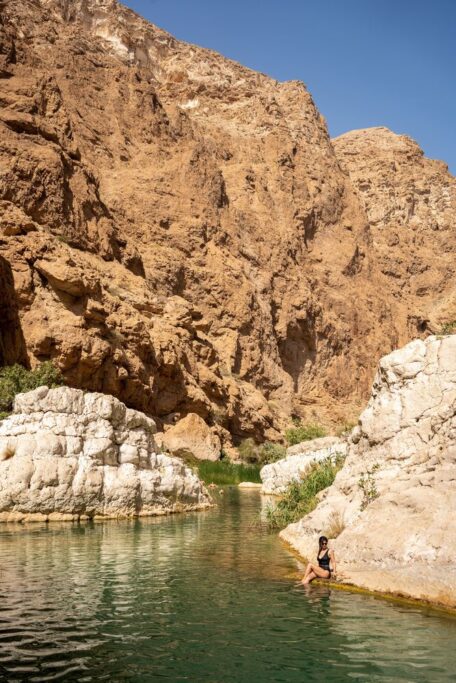
Wadi Shab is one of those places that makes Oman look almost unfairly beautiful: towering canyon walls, emerald pools, a proper hike, and — if you make it all the way to the end — a hidden waterfall inside a cave.
First, though, you need to find the entrance.
When using Google Maps, search for “Wadi Shab Parking” rather than simply “Wadi Shab.” The parking area is just off Route 17. GPS pins for wadis can be misleading because they are sometimes dropped somewhere in the middle of the riverbed rather than at the actual access point. We learned this the irritating way, after following a dirt road into the mountains for around half an hour.
If you’re exploring Oman independently, having your own wheels makes visiting the wadis much easier. You can compare rental-car prices here.
The small parking area is free. From here, the adventure starts with a short boat crossing over the water at the mouth of the wadi. The round trip costs 1 OMR according to the original visit information.
Don’t leave this crossing until late in the day. Boat service finishes in the late afternoon — the original visit notes a closing time of 5:30 PM — and you definitely don’t want to discover that the last boat has left while you’re still on the opposite bank. Check the current return time with the boatmen before you start hiking.
Hiking into Wadi Shab
Wadi Shab makes you work a little for the reward, which is part of its charm.
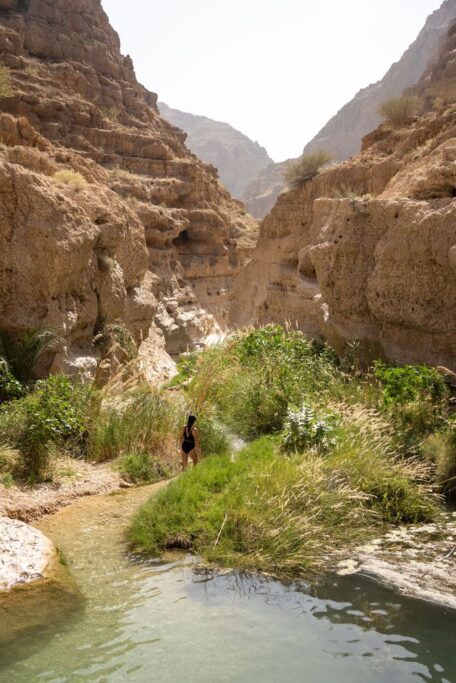
Allow around 45 minutes to one hour each way for the hike before adding swimming time. The trail winds deeper into the canyon beside green-blue pools, palms, rock ledges, and enormous walls of stone.
The route isn’t technically difficult for most reasonably active travelers, but the heat is the bigger challenge. There is very little shade in places, so bring plenty of water, sunscreen, sunglasses, snacks, and a hat.
Good footwear also matters. Sneakers or hiking shoes are much more sensible than ordinary sandals because some sections of rock have been polished smooth by thousands of feet and can become slippery.
Where the hike turns into a swim
Eventually you’ll reach a large pool where the dry part of the journey effectively ends. From here, you need to continue through the water.
This is where a dry bag becomes extremely useful. Put your phone, keys, wallet, camera, and anything else that should definitely not go swimming inside it.
The aquatic section alternates between swimming, wading, and scrambling over submerged or wet rocks. Water shoes are particularly handy here. If you have a pair of river shoes, bring them in your bag and change before entering the water. It saves you from hiking back in soggy sneakers later.
And then comes the reason so many people rave about Wadi Shab.
Near what appears to be a dead end, swim to the right and look for a narrow opening in the rock. Squeeze through and you emerge inside a hidden cave with a waterfall cascading into deep water.
You can’t stand on the bottom here, so you need to be a confident swimmer.
There’s also a short adventurous route around the waterfall, including a rope-assisted climb and a higher pool, before looping back towards the main cave. It is easily the most memorable part of the whole wadi.
Best time to visit Wadi Shab
Go early. Wadi Shab is one of Oman’s best-known natural attractions and naturally gets much busier later in the day.
A weekday morning gives you the best chance of enjoying the pools before tour groups arrive. Even with other visitors around, however, the canyon is large enough that the experience can still feel wonderfully wild once you hike farther inside.
| No rental car? You can also book a guided Wadi Shab day trip from Muscat here. |
Where to stay near Wadi Shab
| Tiwi is the easiest base if Wadi Shab is high on your itinerary. The town is only a few minutes from the entrance, which makes an early start much less painful. You can check this affordable property with sea-view balconies or this alternative in Tiwi. → See all hotels in Tiwi Alternatively, stay in Sur, which offers more restaurants and accommodation but sits farther down the coast. |
2/ Wadi Damm
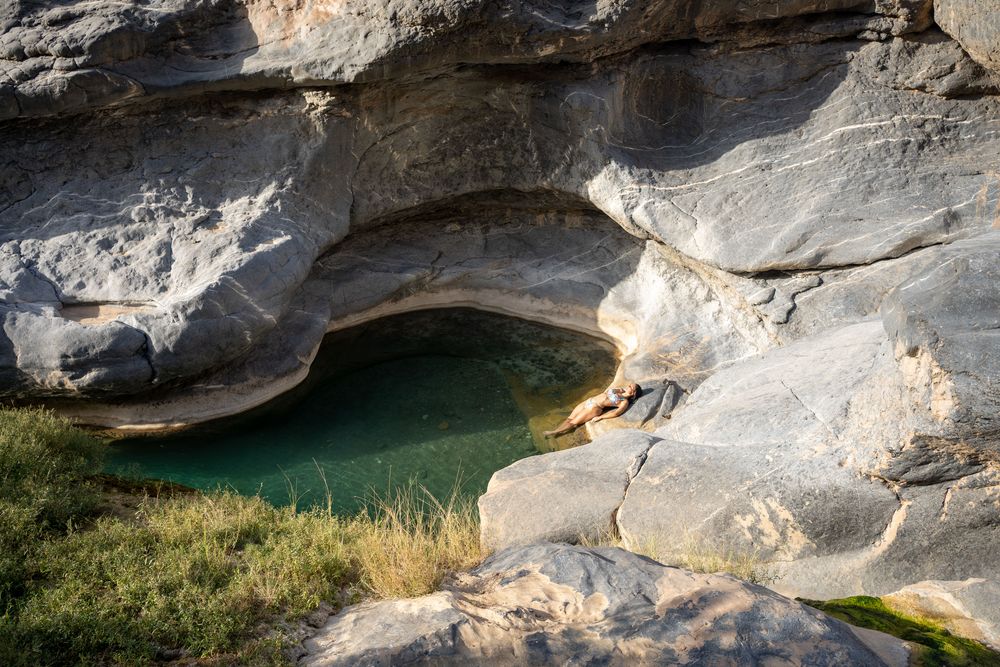
If Wadi Shab is the headline act, Wadi Damm is the slightly secret encore.
It receives far fewer visitors than Wadi Shab or Wadi Bani Khalid, and that changes the atmosphere completely. On the original visit, there wasn’t another person around — just rock, turquoise water, silence, and a succession of natural pools hidden deeper and deeper inside the canyon.
The prettiest one comes near the end of the hike, where water trickles from a fissure in the cliffs between moss and flowers. Allow roughly one hour to reach it, although you’ll pass several tempting swimming spots along the way.
Finding Wadi Damm
As with Wadi Shab, the GPS point matters.
Search for “Wadi Damm Parking” rather than simply Wadi Damm. At the fork, take the road to the left instead of continuing along the rougher track.
Once parked, follow the falaj irrigation channel. After roughly 20 minutes you’ll arrive at a dam, which was dry on one side during the original March visit.
From the first pool, continue for another 20 minutes or so over rocks and alongside the water.
Eventually you’ll reach a large natural basin that’s ideal for swimming and jumping in. Plenty of visitors could happily stop here, but if you’re comfortable with a slightly more adventurous route, keep going.
To continue, you’ll need to use a fixed rope to pull yourself onto a large rock on the left.
It looks slightly intimidating, but the reward is the most beautiful section of Wadi Damm.
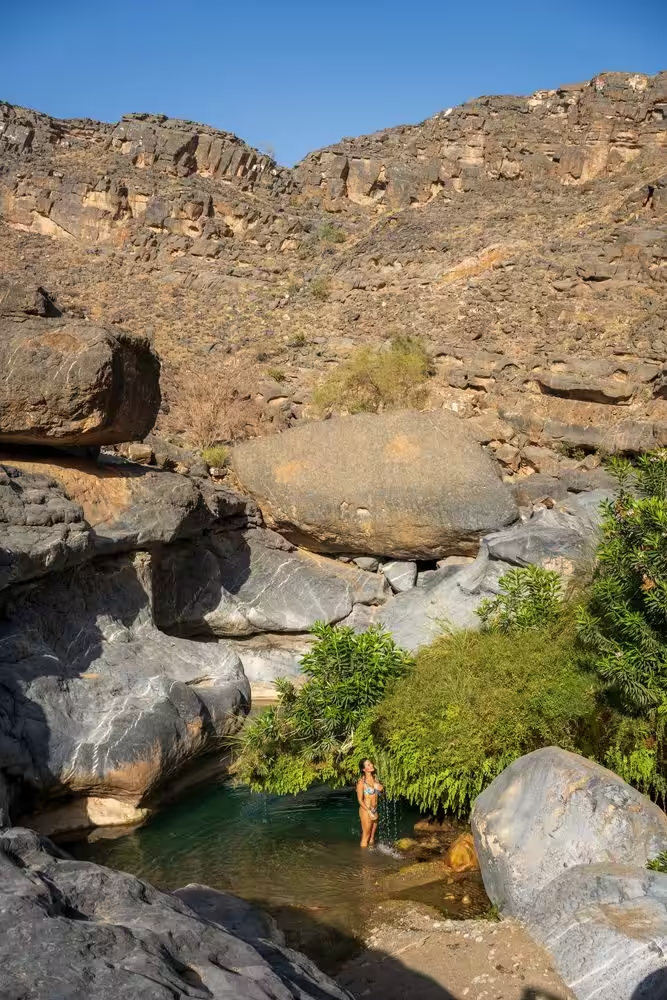
Continue for another 15 minutes or so. Around the point where the canyon bends left, you’ll discover a gorgeous turquoise pool fed by a small waterfall.
Water slips through a fissure in the cliff, surrounded by moss, oleanders, figs, and pockets of greenery that look almost bizarre against Oman’s dry mountains.
You can swim beneath the falling water, float in the pool, and wonder how somewhere this pretty has managed to remain so quiet.
The original trip even included camping on a little sandy patch beside the wadi, followed by another swim the next morning. If you enjoy quieter, less polished adventures, Wadi Damm is arguably one of the most rewarding wadis on this list.
3/ Wadi Bani Khalid
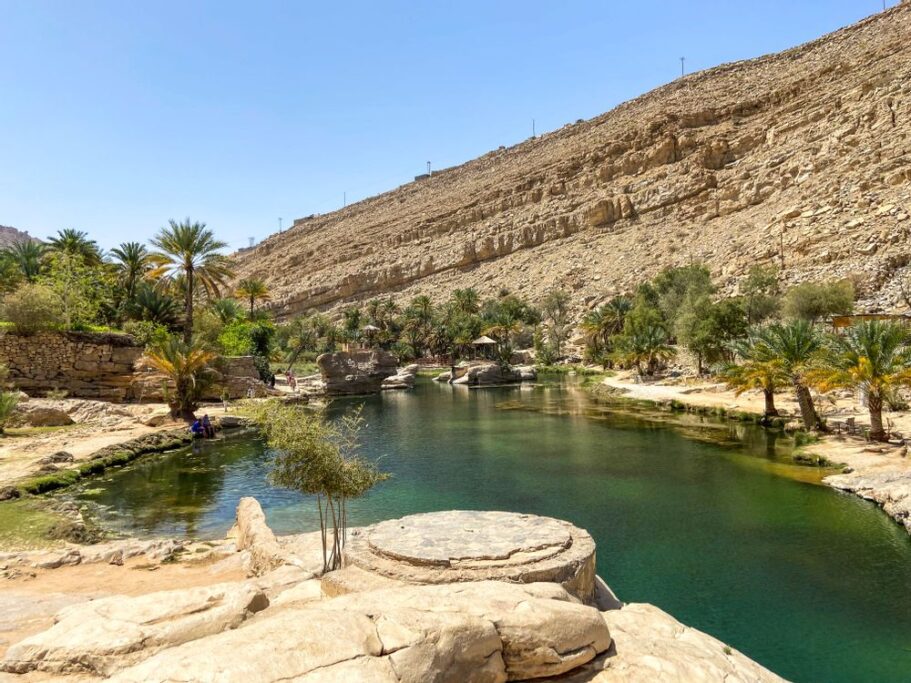
Wadi Bani Khalid is one of the easiest wadis to combine with the Wahiba Sands, making it an ideal stop either before heading into the desert or after spending a night among the dunes.
It’s also considerably easier to access than Wadi Damm.
From the parking area, follow the irrigation channel and within a few minutes you’ll arrive at the first main pool.
This lower section feels more developed than some of Oman’s wilder wadis. The pool is enormous, surrounded by palm trees, pathways, and small bridges, and it’s especially popular with local visitors.
Even if you don’t swim here, it’s a lovely place to sit at the water’s edge. Tiny fish may even start nibbling at your feet — essentially a free and rather unexpected fish pedicure.
There is also a small restaurant at the site, although it was closed during the original visit.
The upper pools at Wadi Bani Khalid
Don’t stop at the first pool.
Walk for around 10 minutes over the rocks — sneakers with decent grip are useful — and the scenery becomes dramatically better.
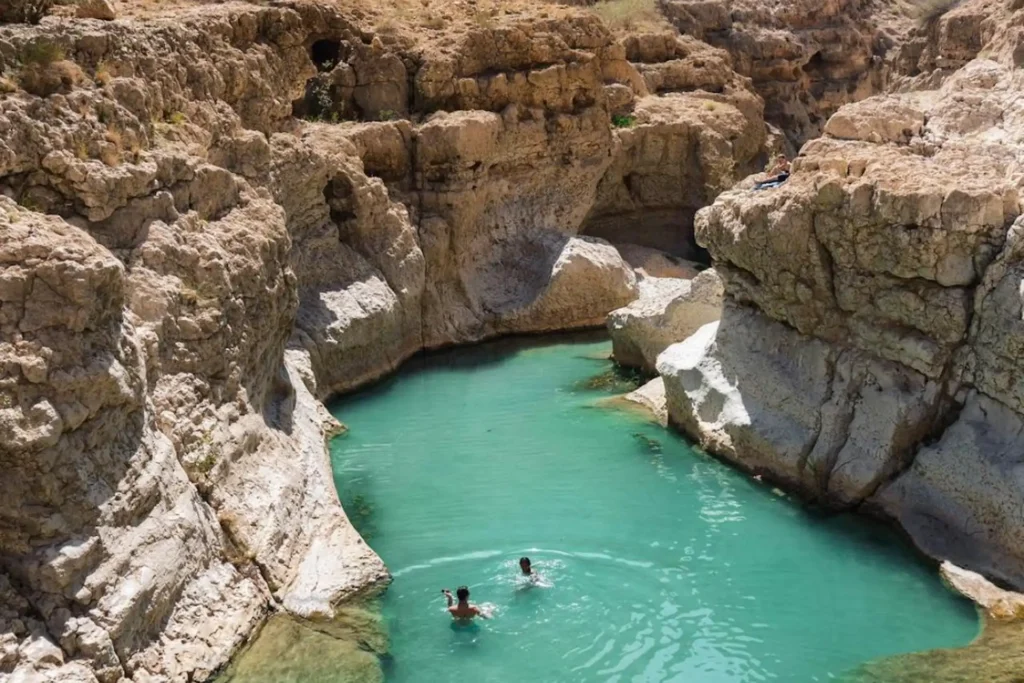
Here, brilliant turquoise water threads its way through a narrow rocky canyon, creating long natural swimming channels beneath the cliffs.
The water is beautifully clear and the shape of the canyon makes parts of it feel almost like a giant natural lap pool.
There’s even a small waterfall that works like a natural slide, spilling down beside the path into the swimming area.
It’s very easy to lose an hour here.
Muqal Cave
If you still have energy, you can continue farther into the wadi towards Muqal Cave.
The cave is about another 10 minutes along a rocky trail.
It’s not a spectacular show cave with dramatic formations, so don’t expect underground fireworks. The main appeal is simply exploring deeper into the landscape and spotting the bats that live inside.
There is no natural light once you get farther in, so bring a flashlight or make sure your phone has enough battery to use its torch.
If you don’t have a car, you can combine Wadi Bani Khalid and the Wahiba Sands on a guided trip from Muscat here.
Where to stay near Wadi Bani Khalid
| Rather than staying directly beside the wadi, it makes sense to combine this part of Oman with a night in the Wahiba Sands. That gives you desert sunset and sunrise without having to squeeze everything into one frantic day. This desert camp stands out for its open-air cinema and atmospheric setting. It’s worth booking ahead because popular desert camps can fill surprisingly quickly. Another option is this highly rated camp. And if coming back from the desert coated in sand makes a swimming pool sound particularly appealing, this camp and this one are among the options with pools. → See all camps in the desert |
4/ Wadi Al Arbeieen
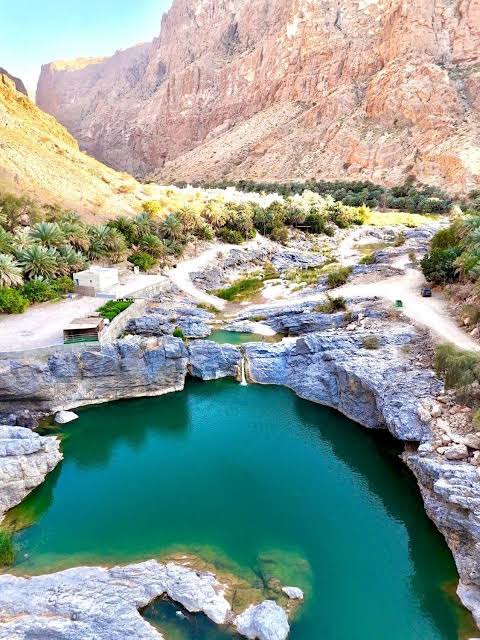
If you’re after something wilder and more remote, Wadi Al Arbeieen delivers.
Access is trickier than at Wadi Shab or Wadi Bani Khalid, and a 4×4 is recommended for the route.
Part of the appeal is precisely that sense of remoteness. Stay at Wadi Al Arbeieen Resort and you’re surrounded by mountains, canyon walls, and very little else.
The resort’s simple white cottages blend into the landscape rather than trying to compete with it.
One of the highlights during the original visit was taking the hotel’s kayaks out onto the water. Paddling through the canyon towards sunset, with the last light slipping between the rock walls, is exactly the sort of experience that makes you understand why people become slightly obsessed with Oman.
Don’t miss the other pools
There’s one important catch: Wadi Al Arbeieen is bigger than it first appears.
During the original visit, only the pool beside the resort was explored. It was only afterwards that it became clear that some of the wadi’s most beautiful pools were sitting frustratingly close by.
When approaching the resort, look for a small road turning off to the right shortly before the hotel. This leads towards another section of the wadi.
There was no reliable mobile signal in the area during the visit, which makes it worth saving maps or directions offline before you arrive.
Without internet access, it’s surprisingly easy to assume you’ve reached the main attraction when another extraordinary pool is hidden just around the corner.
Where to stay near Wadi Al Arbeieen
| If you want to wake up surrounded by the wadi rather than drive back towards the coast, Wadi Al Arbeieen Resort is the obvious choice. The setting is the real luxury here. Book ahead if your dates are fixed, as accommodation in such an isolated location is naturally limited. |
5/ Bimmah Sinkhole
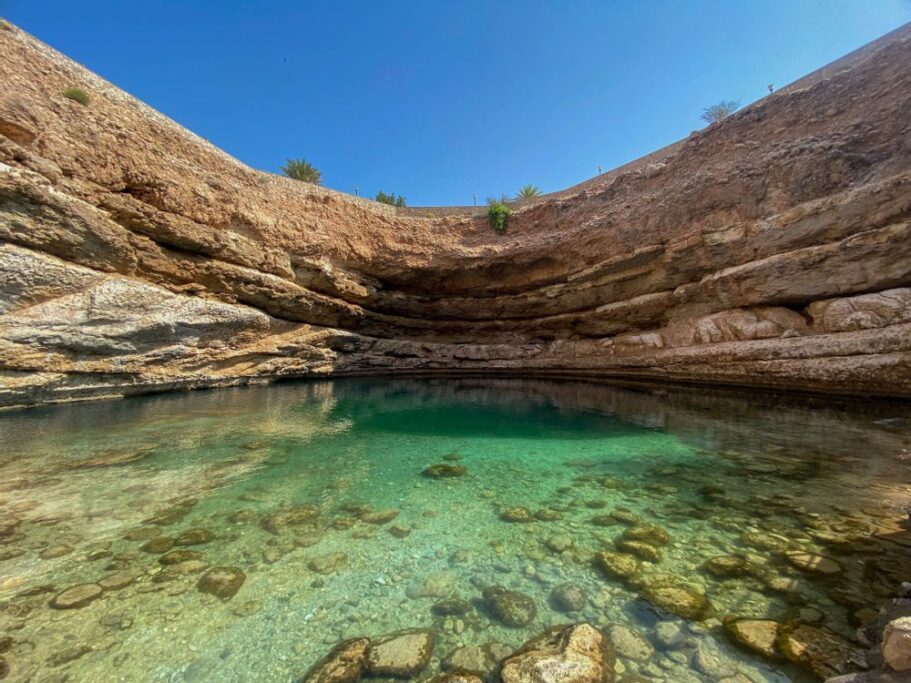
Technically, Bimmah Sinkhole isn’t a wadi at all.
But if what you’re really looking for is brilliant blue water surrounded by dramatic rock — preferably with the option of jumping in — it earns its place on this list.
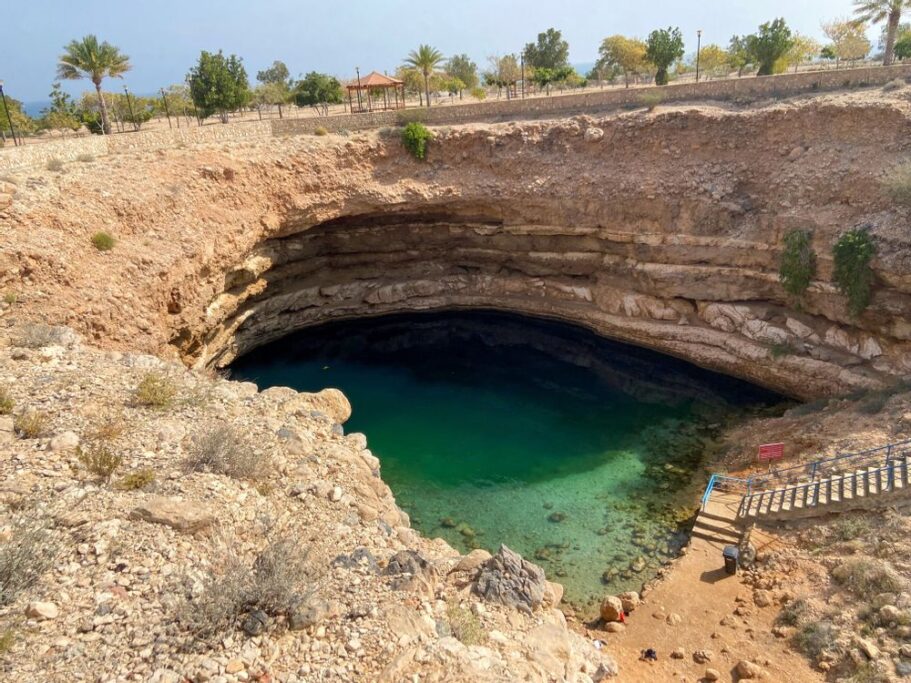
Bimmah Sinkhole is an enormous open-air limestone depression, around 50 metres across, filled with startlingly clear turquoise water.
The pool reaches significant depth in places — around 20 metres according to the original information — but unlike the more adventurous wadis, getting into it couldn’t be much easier.
A staircase leads directly down to the water.
There’s a wonderfully dramatic local story that the crater was created by a meteorite.
The scientific explanation is rather less cinematic: the limestone beneath the surface gradually dissolved and collapsed, creating the sinkhole you see today.
Is Bimmah Sinkhole worth visiting?
Yes — especially because it is so easy to combine with other stops.
The sinkhole sits inside a landscaped public park with lawns, picnic areas, and a children’s playground. Admittedly, the manicured setting removes some of the wild atmosphere you get at places like Wadi Damm, but it makes Bimmah extremely accessible.
There’s virtually no hike involved. The distance from the parking area to the crater is tiny, and admission is free according to the original visit information.
Best of all, Bimmah Sinkhole lies between Muscat and Wadi Shab, making it one of the easiest natural attractions to slot into an Oman road trip.
You don’t need to devote an entire day to it. Stop for a swim, admire the improbable colour of the water, have a picnic if you have time, and then continue along the coast towards Wadi Shab and Tiwi.