
Travel writing based on first-hand experience
Pamukkale is one of those places that doesn’t feel real until you’re standing on it—white, rippled terraces spilling down a hillside like frozen clouds, mineral pools glowing baby-blue in the sun. But there’s so much more than the famous postcards. You can wander the ancient streets of Hierapolis, float over the terraces in a hot-air balloon at sunrise, soak in Cleopatra’s fizzy thermal pool, and chase viewpoints that switch from dreamy pastels at dusk to star-sprinkled skies at night. In this guide, I’ll show you the absolute best things to do in Pamukkale—easy wins, hidden corners, where to eat, when to go, and how to avoid the bus tours—so you can spend less time figuring it out and more time barefoot in the warm water.
Planning more Turkey nature, history, and hot spring adventures? Read these next
Table of Contents
Know Before You Go to Pamukkale
- One ticket = two icons. Your entry covers the travertine terraces and the ancient city of Hierapolis just above them. Two for one, basically.
- Shoes off, always. You’ll walk barefoot on signed paths to protect the calcite. Toss your sandals in a tote or small drawstring bag.
- It’s slick in spots. Wet limestone can surprise you—keep a hand free and slow your roll.
- White glare is real. Sunglasses, hat, SPF. The terraces bounce sunlight straight into your eyeballs.
- Three ways in. Lower Town (right by the terraces), South Gate (handy for driver/tours), North Gate (closest to the necropolis and theatre).
- Little shuttles help. Paid golf carts zip around Hierapolis if you’d rather not hoof it.
- Cards work, cash helps. Gates and cafés take cards; tiny kiosks may prefer lira.
- Swimming’s separate. The Cleopatra Antique Pool charges its own fee. Pack a swimsuit and quick-dry towel.
- Treat it gently. Stay on marked routes, don’t touch or chip deposits, and avoid slathering fresh oils/lotions right before wading.
What Makes Pamukkale Unique?

- It’s “alive.” The terraces are still forming as mineral-rich springs lay down fresh ribbons of white. You’re literally walking on geology mid-performance.
- Nature + ruins, side by side. Few places serve a Roman spa town and a sci-fi landscape in the same glance. Hierapolis crowns the hill; the pools gleam below.
- Color mood swings. Pools shift with flow and light—chalk white at noon, soft blue at dusk, sometimes a blush of pink after rain.
- Two millennia of soaking. From Apollo’s followers to Christian pilgrims, people have been coming for the waters forever.
- Neighboring quirks. Karahayıt bubbles up iron-rich red springs; Kaklık Cave hides travertine in a twinkly limestone cavern.
How Many Days in Pamukkale?
- Whirlwind (½–1 day): Walk the terraces, peek at the theatre, museum, Apollo/Plutonium.
- Sweet spot (1.5–2 days): Add a Cleopatra Pool soak, the long necropolis walk, plus Laodicea or Kaklık Cave/Karahayıt.
- Slow and rich (2–3 days): Fold in Tripolis and Yeşildere Waterfall, aim for both sunrise and sunset, and schedule thermal downtime.
Is it Worth Visiting Pamukkale?
Absolutely. Even if you’ve seen a thousand photos, the moment your bare feet hit warm, rippled stone while a Roman theatre frames the skyline—yeah, it lands. If you’re crowd-averse, go early or late, and consider staying the night. The golden hours here are magic.
How to Get to Pamukkale?
- Fly: Denizli Çardak (DNZ), then shuttle/taxi/rental car—about an hour to the village.
- Bus/train: Roll into Denizli from major cities; minibuses or taxis cover the last 20 km.
- Drive: Rough times—İzmir ~3.5h, Antalya ~3–3.5h, Bodrum ~3.5–4h. A car makes side trips easy.
- Getting around: Inside the site, you’ll mostly walk; paid golf carts cover long stretches on the plateau. Taxis connect Pamukkale, Karahayıt, and Denizli smoothly.
When to Visit Pamukkale?
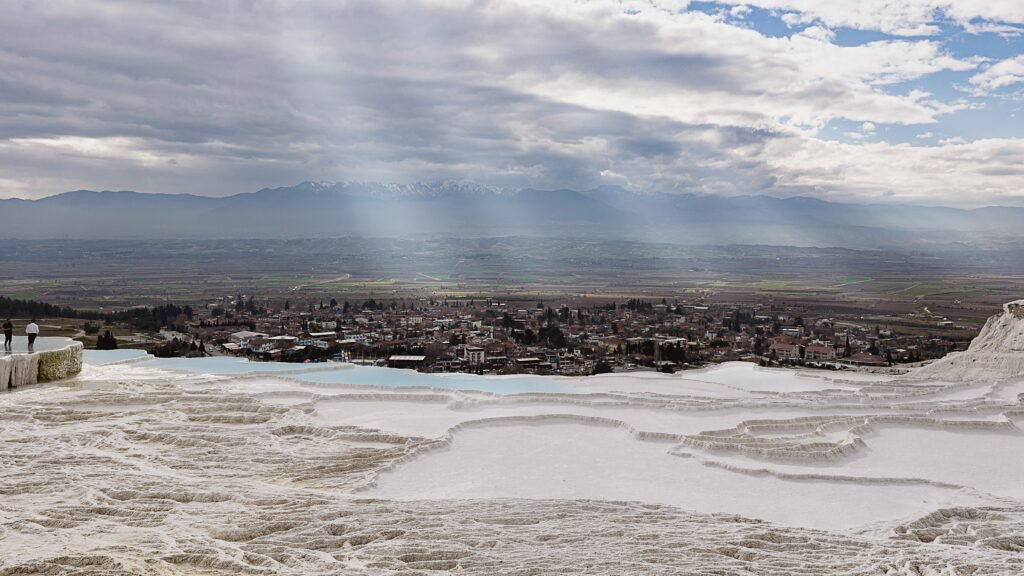
- Best seasons: April–May and September–October—gentle temps, prettier skies, thinner crowds.
- Summer: Hot and bright. Plan sunrise and sunset sessions; hide midday in the museum or a shady café.
- Winter: Quiet, cool, moody steam drifting over warm flows—shorter days, occasional rain; bring layers.
- Best daily timing: Sunrise for solitude, late afternoon for glow. Midday is brightest—also busiest.
What to Expect When Visiting the Travertines
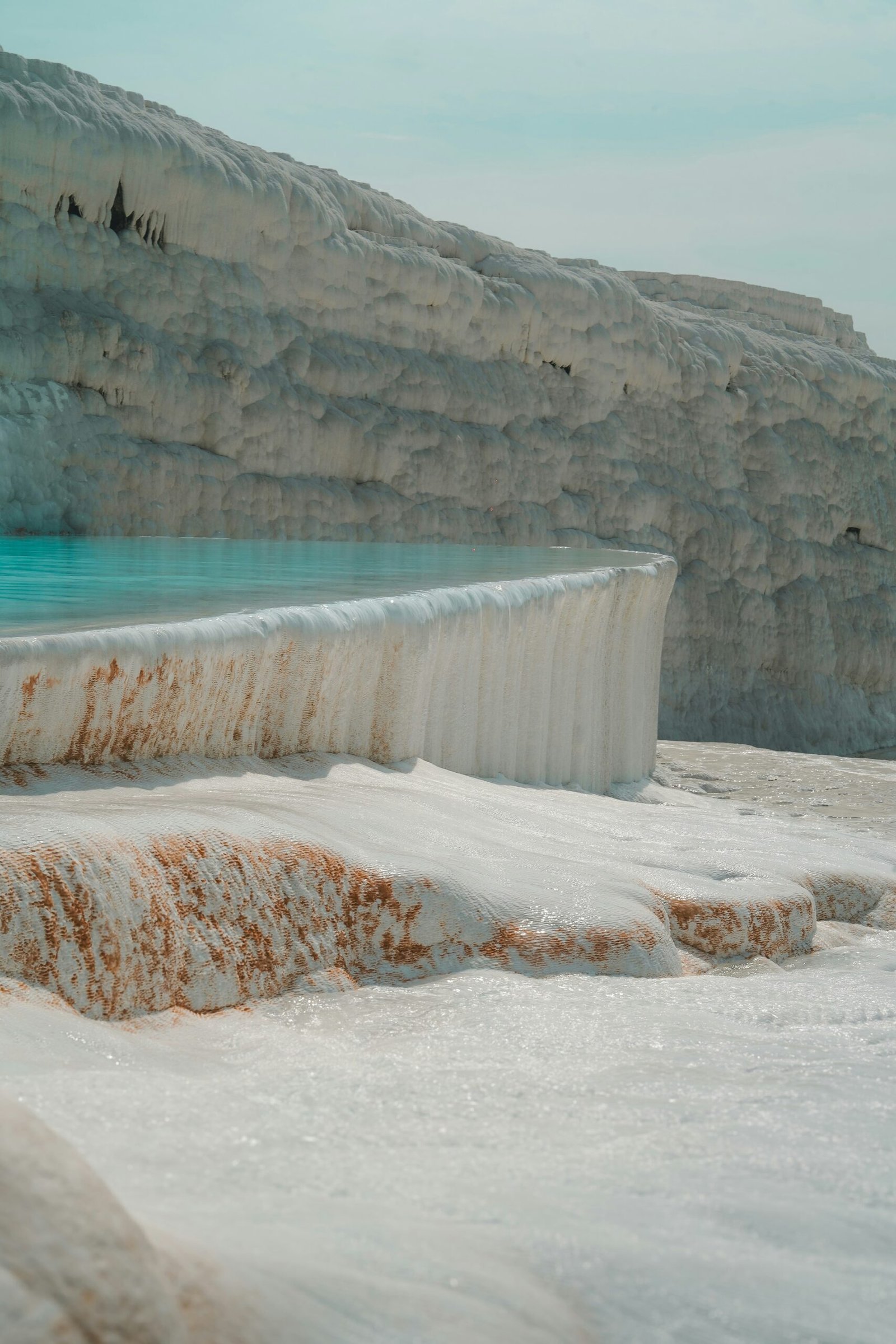
- The climb. From the Lower Entrance you’ll pad uphill through shallow channels. It’s steady, with plenty of “wow, look at that” pauses.
- Water rotation. Rangers redirect the flow to let some basins “rest.” If a famous pool is dry, another section will be shimmering—promise.
- Facilities where you need them. Restrooms and cafés are near the gates and Cleopatra Pool. Keep small cash for lockers/snacks.
- Feet feel things. The surface alternates between warm, smooth calcite and nubbly natural grip. Some bits are slick—keep kids close and phones leashed.
- Photo rhythm. Move a little farther along the path to escape the cluster. Sunrise gives pastel reflections; sunset catches the theatre in honeyed light.
- Weather vibes. It’s breezier on the plateau. Even in warm months, a light layer can feel good once you stop moving.
- Perfect pairing. After the terraces, poke around Hierapolis Theatre and the Archaeology Museum, then reward yourself with a soak—classic Cleopatra Pool or the iron-rich baths in Karahayıt.
Where to Stay in Pamukkale (Luxury, Family, Budget)
A quick map of the scene: you’ve got Pamukkale village at the foot of the terraces (walkable, cozy), Karahayıt a few minutes away (thermal spa hub with red-mineral waters), and Denizli city (~20 km; best for transport links and big-hotel value). Here’s the short list that actually helps you decide.
Luxury: thermal bliss + space to unwind
- Doga Thermal Health & Spa (Karahayıt)
Big, modern spa resort with multiple thermal pools (indoor/outdoor), serious hammam and treatment menu, and the most “resort” feel in the area. Rooms are spacious; breakfast spreads are huge. Pick if: spa time is a non-negotiable. - Richmond Pamukkale Thermal (Karahayıt)
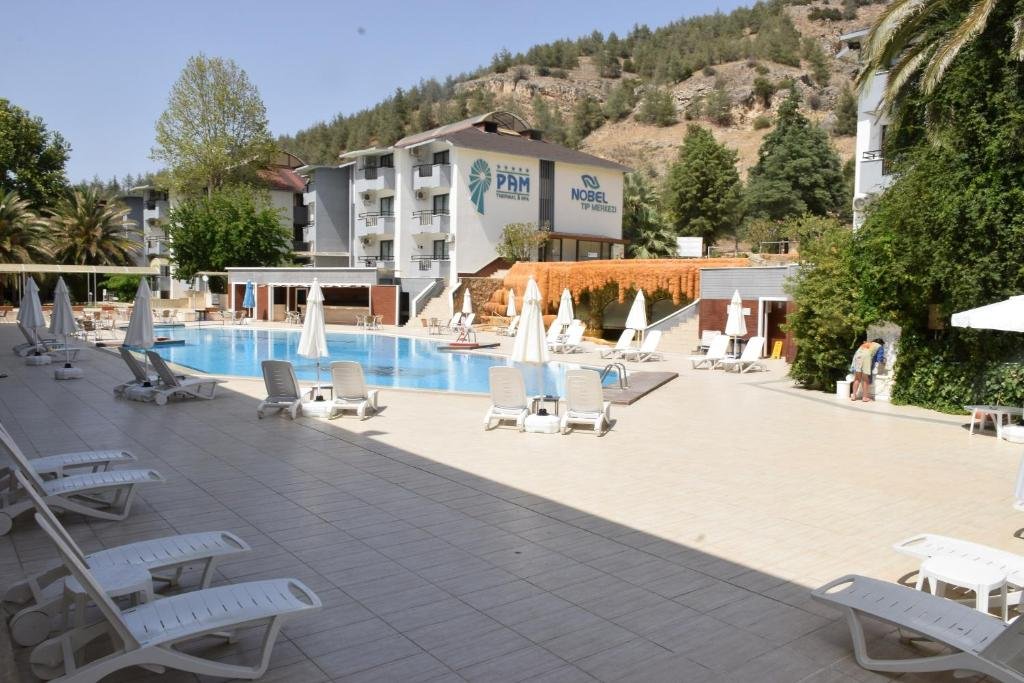
Classic five-star style: leafy grounds, thermal pools, a calm vibe, and consistently polished service. Pick if: you want a traditional upscale stay near (but not inside) the bustle. - Pam Thermal Hotel Clinic & Spa (Karahayıt)
Old-school favorite for therapeutic baths. Strong on water quality, plenty of treatment rooms, quiet after dark. Pick if: you’re here to soak and sleep. - Spa Hotel Colossae Thermal (Karahayıt)
Large property with tennis courts and a good mix of room types. Feels like a self-contained mini-village. Pick if: you want facilities for days.
Luxury pro tip: Stay in Karahayıt for top-tier spas; taxi or minibus to the terraces for sunrise/sunset, then slip back to your thermal cocoon.
Family: walkable, friendly, easy meals
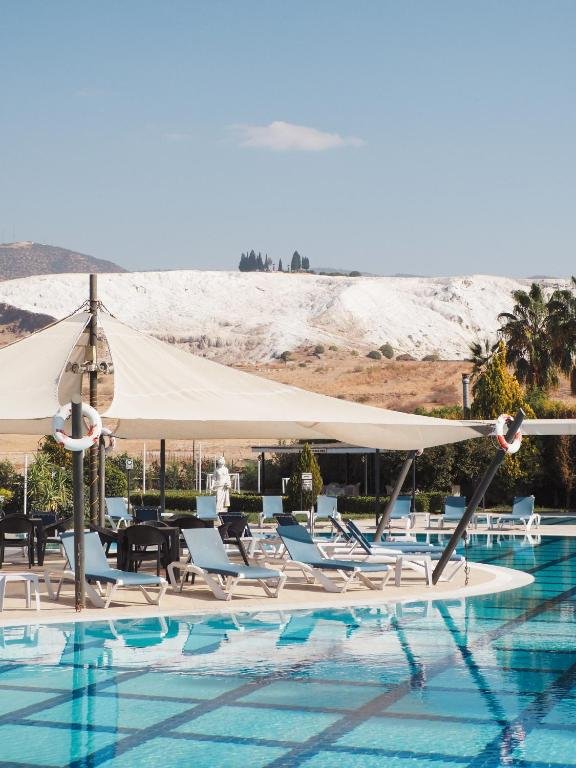
- Venüs Suite Hotel (Pamukkale village)
Bright, roomy family suites, a small pool, and a 10–15 minute walk to the travertine gate. Staff help with strollers, transfers, and terrace timing. - Melrose House Hotel (Pamukkale village)
Homey, green courtyard, a pool for post-terrace cooldown, and family rooms. Their simple dinners save you an extra outing with kids. - Bellamaritimo Hotel (Pamukkale village)
Great value for families who want clean, quiet rooms a short stroll from cafés and the Lower Gate. - Tripolis Hotel (just outside village)
Mid-sized hotel with a bigger pool and sunset views; good for families who want more space but still quick access to the site.
Family pro tip: Book a ground-floor or courtyard-facing room so nap times aren’t a negotiation. Aim for sunrise terraces, then museum/siesta at midday.
Budget: clean, central, no fuss
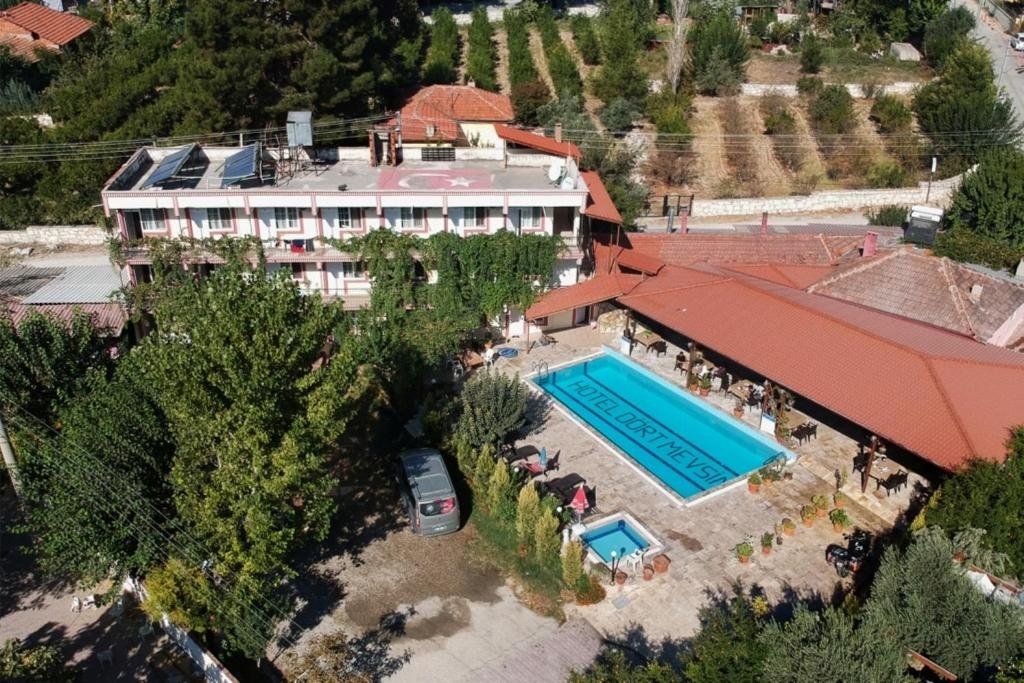
- Beyaz Kale Hotel (Pamukkale village)
Long-running family guesthouse with basic, tidy rooms and a friendly breakfast—steps from the action. - Özbay Hotel (Pamukkale village)
Unpretentious, welcoming, with a handy in-house eatery so you can crash right after sunset at the terraces. - Dört Mevsim Hotel (Pamukkale village)
Solid budget choice with occasional terrace views from upper rooms; owners can arrange transfers and balloon tours.
Budget pro tip: Prioritize location over extras—being able to walk to the gate at dawn beats a slightly nicer room farther away.
Should you base in Denizli city instead?
If you’re arriving late, leaving early, or day-tripping the region by bus/train, Denizli can be convenient (bigger hotels, sharper prices). But for the Pamukkale feeling—bare feet at sunrise, back to your room for a quick rinse—staying in the village or Karahayıt wins.
Best Things to do in Pamukkale
1. Pamukkale Travertines

Why they look like this. Underground waters, supercharged with calcium carbonate, bubble up along a fault line. When the hot water reaches the surface and meets cooler air, the dissolved calcium precipitates as travertine, building ledges and bowl-like pools over millennia. The result is a terraced amphitheatre of shallow basins that can look chalk-white at midday, pearly pink under clouds, or electric blue when the sky pops. Flow and color change with season, rainfall, and management of the springs.
How to visit without harming the site. The terraces are fragile. You’ll be asked to walk barefoot in designated zones; bring a small bag to carry your shoes. Stick to the marked paths—those smooth-looking formations can be sharp or slippery. Some pools are filled for wading; others are left dry to rest. If you’re after those iconic photos, walk a little farther than the first viewpoint—crowds thin quickly.
When to go. Sunrise and the golden hour before sunset are glorious: softer light for photos, fewer day-trippers, and cooler rock. In winter, steam rises from the warm trickles; in summer, expect intense sun reflected off white stone (sunglasses are a must). Spring and autumn bring mild temperatures and wildflowers sprouting around the travertines’ edges.
Entrances & logistics. There are three main access points: the South Gate (useful if you’re driving from Denizli), the North Gate (closest to the necropolis and theatre), and the Lower Town Entrance that brings you up alongside the terraces. All integrate with Hierapolis, so your ticket covers both. Golf-cart shuttles run inside the archaeological zone for a small fee; otherwise, expect gentle uphill/downhill walking between sights.
Photography tips. Polarizing filters can kill reflections—use them sparingly if you want the pools to glow. Look for leading lines where narrow rivulets cascade from pool to pool. After a rain, the travertine shines. In summer, a lightweight scarf helps manage glare and serves as a prop.
Entrance: Free with Museum Card.
Hours: Daily 08:00–18:00 (summer hours often extend).
Author’s tip: Bring a microfiber towel; your feet will get wet between pools, and trampling around with damp soles is a quick way to slip.
Bonus experience: Paragliding & hot-air balloons. Weather permitting, paragliders and early-morning balloons drift over the terraces and theatre. It’s a spectacular way to grasp the scale of the formations and the Roman grid of Hierapolis, and sunrise flights pair well with a post-landing stroll on the still-quiet terraces.
2. Hierapolis Ancient City

Overview. Founded by the Attalid kings of Pergamon in the 2nd century BC and later flourished under Rome and Byzantium, Hierapolis was a spa city where medicine, religion, and leisure intertwined. Earthquakes reshaped it repeatedly; each rebuilding layered more monuments and stories atop the hill. Today, straight Roman streets, bath complexes, and churches ring the plateau above the travertines.
Classic route. Enter via the Gate of Domitian and stroll along Frontinus Street, once flanked by shops and fountains. Pop your head into the Latrium (sanitary structures and latrines) to appreciate Roman pragmatism. Continue to the Agora, where traders hawked goods to pilgrims who came seeking cures. Farther north spreads the Necropolis, one of Anatolia’s largest—rows of sarcophagi, evocative house tombs, and tumuli that echo the wealth (and mortality) of a spa city.
Temple of Apollo & the Plutonium. The city’s spiritual core centered on Apollo, protector against earthquakes. Below the temple lies the Plutonium, a small cave venting poisonous carbon dioxide once believed to be an entrance to the underworld. Ancient priests likely staged oracles here, using the lethal vapors to their advantage. Don’t worry: modern barriers protect visitors.
Baths & early Christianity. The Great Baths speak to the city’s therapeutic reputation and now house the archaeological museum (see below). Later, Hierapolis became a Christian center; basilicas and the martyrium of St. Philip (more below) testify to that shift. The layered sacredness—from pagan springs to Christian pilgrimage—makes wandering Hierapolis unusually compelling.
Location link
Entrance: Museum Card accepted.
Hours: Daily 08:00–18:00.
Author’s tip: The site is expansive—budget at least half a day. If you only have two hours, prioritize the theatre, Apollo/Plutonium, and a slice of the necropolis closest to the North Gate.
3. Cleopatra Pool

What it is. A spring-fed basin enclosed within a shaded garden, littered with toppled marble columns you can actually float over. The water sits toasty year-round (often quoted between 36–57°C) and is rich in minerals that locals prize for skin and joint relief.
Experience notes. There’s a separate fee for swimming; lockers and changing rooms are on-site, and a café overlooks the pool. Early morning and late afternoon are mellow; midday can be busy with tour groups. If you’re not swimming, it’s still worth peeking in—those sunken columns are a mood.
Location link
Author’s note: Temporarily closed at times for maintenance—confirm status the day you visit.
4. Hierapolis Archaeological Museum

Housed in the restored Roman baths, this compact museum lays out Hierapolis in digestible chapters: funerary art from the necropolis (sarcophagi carved with mythic scenes), statues, inscriptions, mosaics, coins, and domestic items that hint at everyday life in a spa city. It’s ideal as a midday pause—cool stone halls, concise labels, and a tight curation that connects what you’ve seen outside to context inside.
Location link
Included with Hierapolis entry. Hours: Daily 08:00–17:00. Author’s tip: Save it for the heat of the day; you’ll appreciate the shade and the narrative reset before pushing on to the theatre.
5. Hierapolis Ancient Theatre

Carved into the hillside, the theatre fuses Greek siting with Roman showmanship. Seating for about 12,000 rises in orderly tiers divided by stairways; climb to the top for a panoramic sweep across the travertines and the valley beyond. The stage façade is the star—colonnades and marble reliefs depicting gods and mythic dramas, among the finest anywhere in Anatolia (comparisons are often made to Perge). Recent restorations used original blocks wherever possible, making performances here feel almost time-warped.
Location link
Included with Hierapolis entry. Hours: Generally 08:00–21:00 in high season. Author’s tip: Bring water; those steps are a glute workout in summer. Sit on the uppermost bench at sunset and watch the terraces blush below.
6. Laodicea Ancient City

About 15–20 minutes from Pamukkale, Laodicea sits on a wind-brushed plateau with views across fertile plains. Founded in the Hellenistic era and enriched under Rome, it was a commercial powerhouse famed for textiles and banking—and it’s one of the Seven Churches of Asia mentioned in the Book of Revelation. Excavations are active, so every year seems to reveal something new: glass-floored walkways over mosaics, re-erected colonnades, and basilicas that map the city’s Christian turn.
Don’t miss the twin theatres (Greek- and Roman-style), the Stadium ridge, the Syria Street colonnade, and the Octagonal Church complex with its elegant baptistery. The site is spacious and, compared to Hierapolis, much quieter—great for slow photography and reflection.
Location link
Entrance: Museum Card valid. Hours: Daily 08:00–17:00. Author’s tip: Wear a hat—the site is exposed and can be breezy; that combo sneaks up on you.
7. Kaklık Cave

Nicknamed “Underground Pamukkale,” Kaklık Cave is a limestone cavern where mineral-laden water has sculpted terraces, stalactites, and rimstone dams that gleam white under subtle lighting. A wooden walkway loops around turquoise pools; light shafts from the sinkhole entrance paint the scene theatrical. Locals have long bathed in the water for skin conditions; today, there’s also a small outdoor pool near the exit fed by the same spring.
Location link
Entrance: ~30 TL (subject to change). Hours: Daily 09:00–19:00. Author’s tip: The walkway can be damp—non-slip shoes help. Go midday for maximum light beams filtering in.
8. St. Philippe Martyrion Church

On a rise north of Hierapolis, the octagonal martyrium honors the Apostle Philip, believed to have been martyred here. The plan—a central octagon ringed by chapels and porticoes—became a model for martyr shrines in the region. Even in ruin, the symmetry is striking. Mosaics and marble fragments peek through grass; the view sweeps across the theatre to the terraces beyond, merging sacred space and landscape.
Location link
Author’s tip: It’s a short but exposed walk from the theatre—time it for late afternoon light and bring water.
9. Karahayıt Thermal Springs

Just a few kilometers from Pamukkale, Karahayıt is the red-hot sibling—literally. Iron-rich waters stain travertine in shades of rust, cinnabar, and ochre, and locals swear by the mud for joints and skin. Many hotels here pipe the thermal water into private pools; public pools and a small park surround the main spring. It’s less photogenic than white Pamukkale but more “local”—think tea gardens, grills perfuming the air, and an unhurried, end-of-day soak.
Location link
Author’s tip: Wear a dark swimsuit if you plan to use the mud—iron can tint light fabrics. Flip-flops are handy; mineral deposits can feel gritty underfoot.
10. Akhan Caravanserai

East of Denizli on the old Silk Road, the mid-13th-century Akhan wraps a Seljuk welcome in finely chiselled stone. A monumental portal embroidered with geometric motifs opens to a courtyard ringed with rooms, stables, a small mosque, and a bath—purpose-built for caravans seeking safety and supplies. Today, the complex hosts exhibits and events, and parts have been adapted for hospitality, letting you imagine camel bells and traders swapping stories under the same arches.
Location link
Author’s tip: Pair Akhan with a lunchtime stop in Denizli—this is tandır lamb country, and local bakeries turn out superb pide.
11. Halıcı Ahmet Urkay Archaeology & Ethnography Museum

Founded by a local carpet magnate, this private museum (currently known to close intermittently) gathers two threads: artifacts from across Anatolia (pottery, glass, coins, small sculptures) and a warm ethnographic collection of textiles, copperware, dowry chests, toys, and household items that anchor Pamukkale’s ancient story in more recent memory. It’s small, personal, and a pleasant complement to the state-run museum in Hierapolis.
Location link
Author’s note: Temporarily closed at times—check on the day if it’s open; if not, save the time for Tripolis or a longer soak in Karahayıt.
12. Ancient City of Tripolis

Straddling the upper Meander valley about 40–45 minutes from Pamukkale, Tripolis rewards those who venture beyond the headline acts. Its name hints at a crossroads—people and trade from three regions mixing here. The Roman theatre (capacity ~15,000) rises over a grid of streets that stitch together baths, an agora, city walls, and a stadium terrace. Excavation is ongoing, but the bones of a once-significant city already stand proud, and the rural setting—vineyards, poplar windbreaks, the river looping below—adds charm.
Location link
Entrance: Free. Hours: Typically 08:00–19:00.
Author’s tip: Combine with Yeşildere Waterfall for a nature break after ruins.
Bonus: Yeşildere Waterfall

Tucked in the Çal district, Yeşildere tumbles 30 meters through a amphitheatre of moss and ivy, misting the air and cooling summer afternoons. A simple path leads to viewpoints where you can feel the spray; picnic tables dot the banks. It’s a gentle, local counterpoint to Pamukkale’s drama—perfect for decompressing after a day of clambering over ruins.
Best Places to Eat in Pamukkale
Pamukkale’s food scene is small, friendly, and super local—think smoky grills, herb-bright Aegean salads, and warm bread baked minutes before it hits your table. Most restaurants cluster in two areas: Pamukkale Village (by the travertines) and Karahayıt (the red-spring/thermal district). If you’re happy to hop 20–25 minutes to Denizli city, your options widen even more with famed kebab houses and patisseries.
Below is a simple, personal cheat-sheet—with exactly what to order—so you can eat really well without overthinking it.
Around Pamukkale Village (by the travertines)
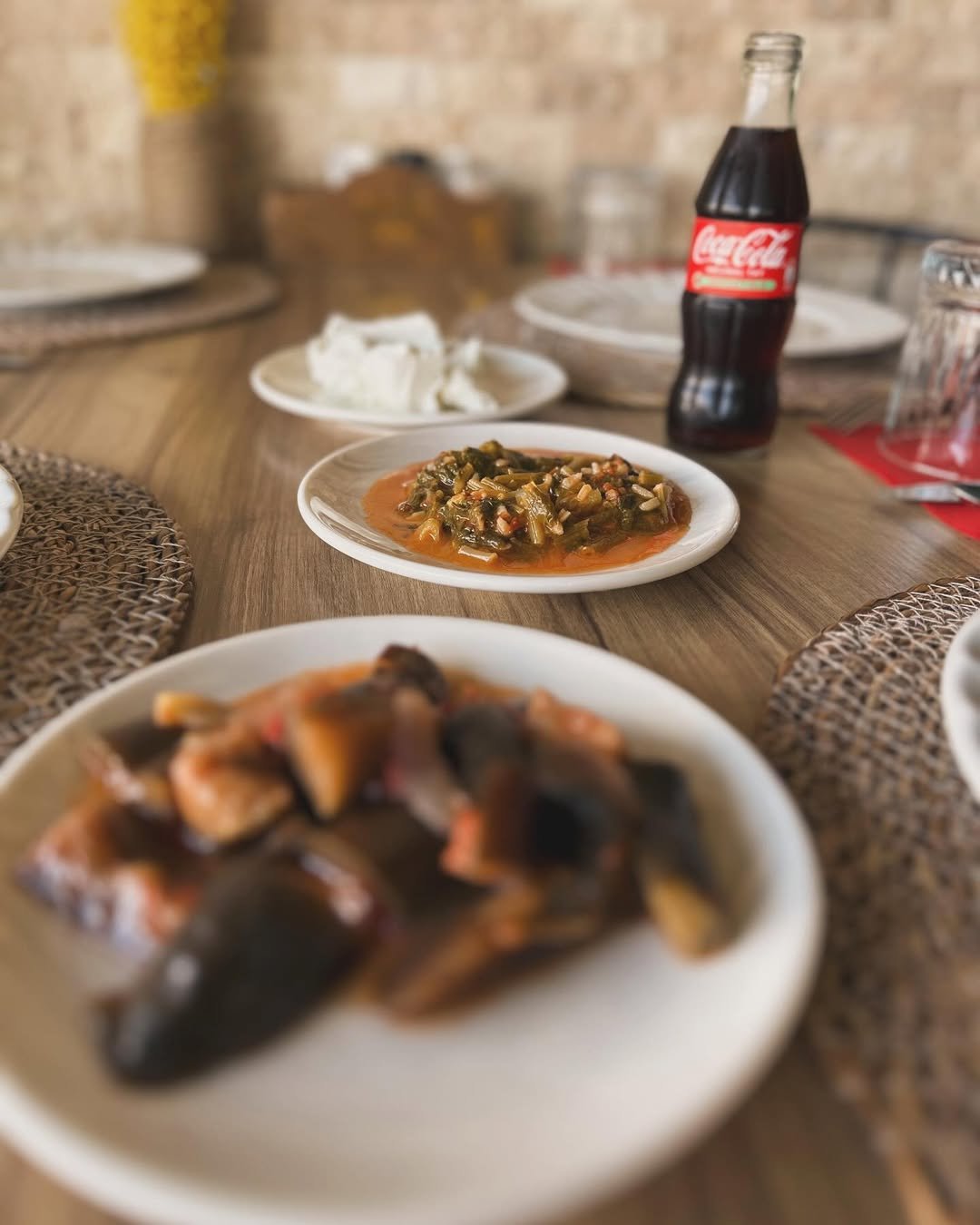
Hiera Restaurant (Coffee & Tea House) – Casual, reliable, and beloved for friendly service. Good all-rounder if you want Turkish staples after sightseeing.
What to order: mercimek çorbası (lentil soup), köfte plate, mixed grill; ask for a side of ezme (spicy tomato–pepper dip).
Kayaş Restaurant & Bar (aka Kayaş Wine House) – Long-running traveler favorite with a garden vibe; hearty grills and simple mezes.
What to order: lamb şiş, tavuk şiş, house meze plate; if you drink, try a glass of Turkish Kalecik Karası.
Tıkır Grill House (Pita & Pizza) – Fast, tasty, budget-friendly; good for families.
What to order: pide (try kıymalı with minced meat or peynirli with cheese), lahmacun, chicken wings.
Bella Bar & Restaurant – Easygoing mixed menu (Turkish + a few international dishes) that keeps everyone at the table happy.
What to order: güveç (baked clay-pot stew), grilled sea bream, menemen for a late breakfast.
In Karahayıt (thermal area, 10–15 min from the travertines)

Kahyaoğlu Pide – Local favorite for fresh-from-the-oven pide; terrific value.
What to order: karışık pide (mixed toppings), sucuklu (Turkish sausage) pide, and a seasonal çoban salad.
Şahin Izgara – Straightforward grill house: juicy skewers, no fuss.
What to order: adana (spicy minced meat skewer), tavuk şiş, yogurtlu kebap if available.
Bezmi Alem Cafe Bistro – Cozy pick near thermal hotels; good for brunch or a lingering tea/coffeebreak.
What to order: Turkish breakfast tray, gözleme, homemade desserts.
Worth the Short Ride to Denizli (bigger city, bigger flavors)
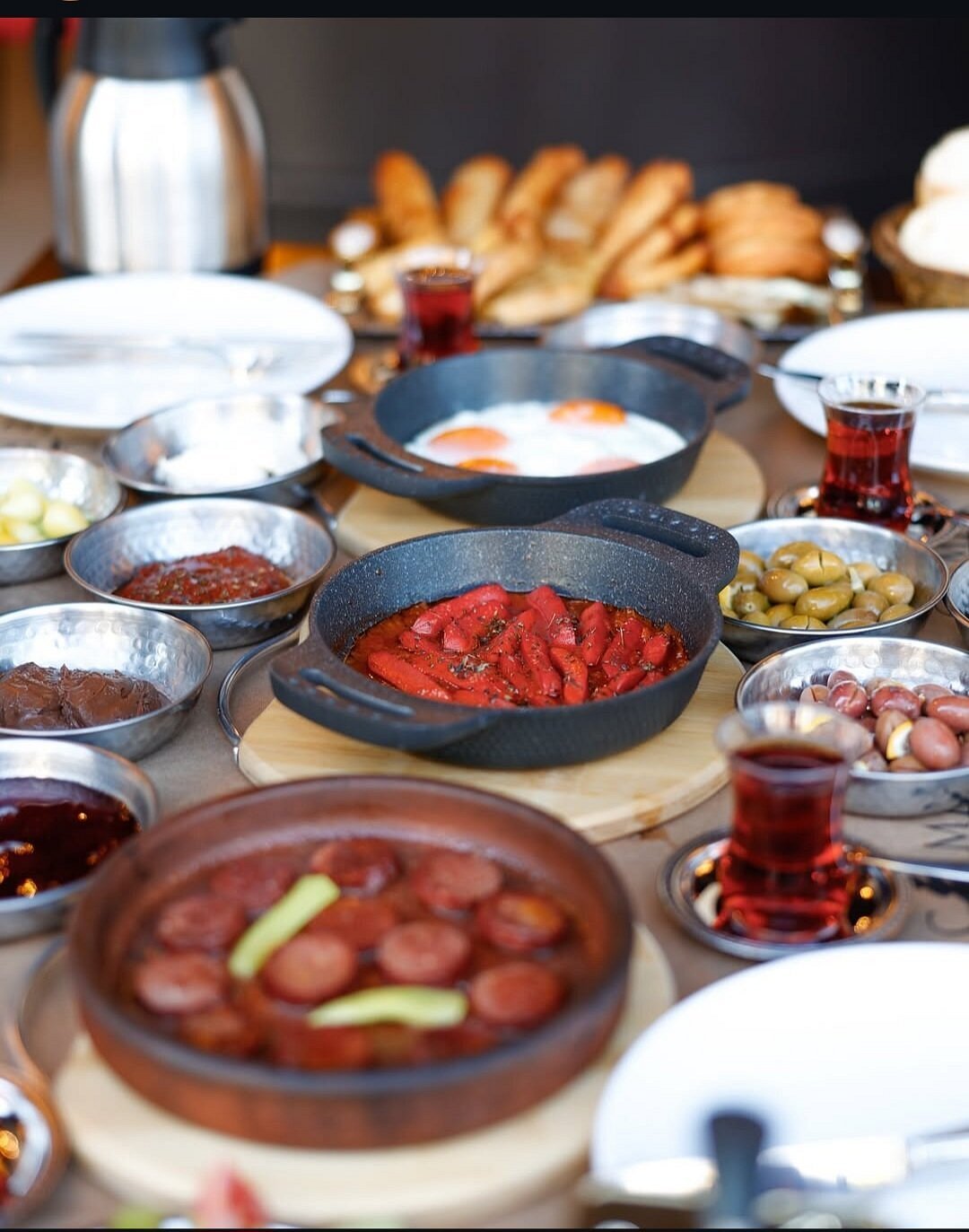
If you can spare a meal in Denizli, do it. This is where you try regional icons you won’t forget.
Denizli Kebabı (Kuyu Tandır) – The city’s signature: slow-roasted lamb, meltingly tender, served simply with bread and salad.
Where to try: established kebapçıs like Çamlık Denizli Kebapçısı and similar classics around town.
What to order: a portion of kuyu tandır with pickled peppers and raw onion—go simple and let the lamb shine.
Baloğlu Pide (and other Denizli pide bakeries) – For a crisp, boat-shaped pie you’ll dream about later.
What to order: kıymalı + kaşar (minced meat + cheese), or spinach-feta if you’re veg-curious.
Sweet Stops – Look for Tavas baklava (a local style) and leblebi (roasted chickpeas) to snack on the bus back.
What to Eat: Local Specialties (so you order like a pro)
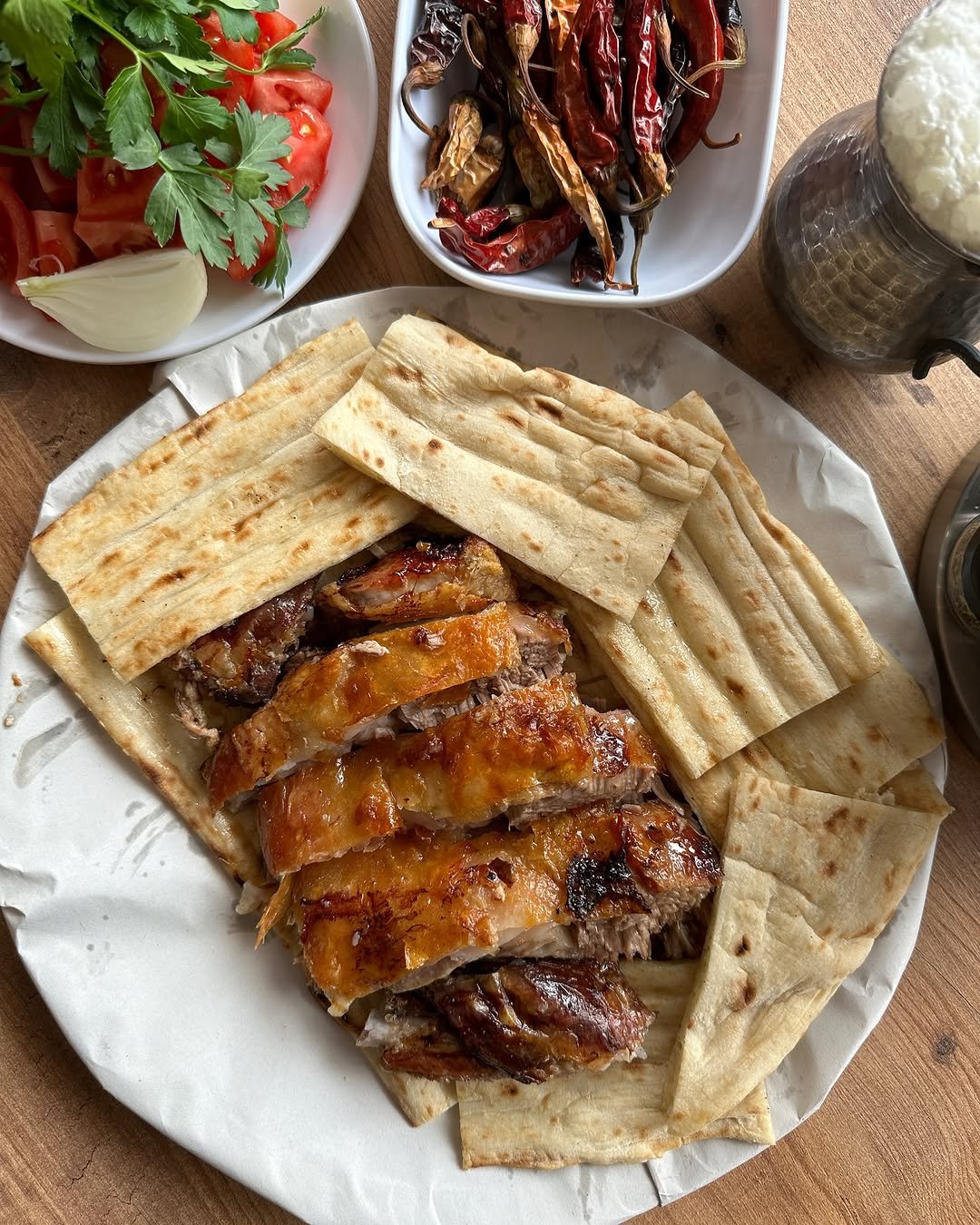
- Denizli Kebabı (Kuyu Tandır): ultra-tender pit-roasted lamb—your must-try.
- Tarhana Çorbası: tangy, comforting soup made from fermented grains and yogurt—especially good in thermal-spa weather.
- Aegean-style salads: börülce (black-eyed pea) salad with tahini-garlic tarator, mallow or sprout salads—herb-forward and lemony.
- Pide & Lahmacun: share a few and add lemon + parsley on top—simple perfection.
- Gözleme: hand-rolled flatbreads filled with cheese, spinach, potato, or minced meat—great for breakfast or a quick bite.
- Tavas Baklava & Roasted Chickpeas (Leblebi): local sweet + salty souvenirs that actually travel well.
Vegetarian, Vegan, and Gluten-Light Tips

- Most grills can do şakşuka (fried veg in tomato), ezme, haydari (yogurt-herb), patlıcan salatası (smoky eggplant), biber dolma (stuffed peppers), pide with cheese/veg, and gözleme with spinach or potato. Ask for etsiz/vejetaryen.
- For gluten-light, load up on mezes, grilled fish/chicken without bread, and salads; ask for glütensiz options. Many places are happy to swap bread for extra salad/fries. (Casual village spots are accommodating even if not officially “gluten-free”.)
Practical Tips for a Smooth Pamukkale Day
Getting there. Denizli Çardak Airport (DNZ) is the nearest, about 1 hour by shuttle or rental car. Trains and intercity buses also connect Denizli with İzmir, Antalya, and Istanbul; minibuses/taxis run the 20 km up to Pamukkale village. Having a car makes it easy to string together Hierapolis, Laodicea, and Kaklık in one long loop.
Where to base. Pamukkale village puts you within walking distance of the lower entrance; Karahayıt suits spa-goers who want hotel thermal pools. For urban amenities, base in Denizli and day-trip.
What to pack. Sunscreen, hat, sunglasses (white travertine amplifies glare), refillable bottle, non-slip sandals you can easily remove, a small shoe bag, and a light towel. In cooler months, a windbreaker for Hierapolis’ exposed plateau. Tripods are typically allowed but be mindful of crowded paths.
Accessibility. Surfaces are uneven. The lower travertine path requires barefoot walking; wheel-friendly access is better from the South Gate to select Hierapolis highlights. Golf carts (for a fee) link major monuments; ask at the gate about routes.
Etiquette & conservation. Don’t wear shoes on the travertines. Avoid sunscreening or applying oils right before wading (they can affect the water). No drones over the terraces without permission. Take only photos; mineral fragments are protected.
Suggested one-day itinerary. Enter early via the lower gate → walk barefoot up the travertines as the light turns gold → coffee break → museum (late morning) → theatre (pre-lunch) → lunch by Cleopatra Pool → Apollo/Plutonium → late-day stroll through the necropolis to the North Gate → sunset photos from the theatre rim → dinner and soak in Karahayıt.
Suggested two-day plan. Day 1: Travertines + Hierapolis core (theatre, museum, Apollo). Day 2: Laodicea (morning), Kaklık Cave (midday), Tripolis + Yeşildere (afternoon), red-water soak in Karahayıt (evening).
Whether you’re coming for the photos, the archaeology, or the steam rising from ancient springs, Pamukkale rewards curiosity. Walk a little farther than the crowds, look closely at carvings weathered by two thousand years of sun, and give yourself time to linger in warm water as the terraces glow. That’s where the place stops being a postcard and becomes a memory you’ll keep.
FAQs: Things to Do in Pamukkale
1) What are the absolute must-dos in Pamukkale?
Walk the travertine terraces, explore Hierapolis (theater, necropolis, Frontinus Street), soak at the Antique (Cleopatra) Pool, visit Karahayıt’s red springs, and catch sunrise/sunset from the upper viewpoints. Balloons and paragliding are the bonus thrills.
2) How many hours do I need?
Bare minimum: 4–5 hours for terraces + main Hierapolis highlights. Better: a full day. Best: 1.5–2 days so you can do sunrise/sunset, the museum, and a soak without rushing.
3) Can you actually swim in the white pools?
You can wade on the travertines in signed areas (barefoot only), but swimming is at the Antique (Cleopatra) Pool and at nearby thermal hotels/springs (e.g., Karahayıt). The terrace basins are fragile—no plunging.
4) Do I have to go barefoot on the travertines?
Yes. Shoes damage the calcite. Bring a small bag to carry sandals; the calcium can feel nubbly, so step slowly.
5) When’s the best time to visit?
Spring (Apr–May) and autumn (Sep–Oct) for mild temps and softer crowds. Summer is hot—go early or late for the light and fewer people. Winter is peaceful; water can be cooler but the experience is still gorgeous.
6) What’s the difference between the three entrances?
- South Gate (Lower/Denizli side): Closest to the travertines’ base; you’ll walk up.
- North/Hierapolis Gate: Good for starting at the ruins/theater and walking down.
- Pamukkale Town Gate (middle): Handy if you’re staying in the village.
Pick based on your plan (up vs. down) and where you park.
7) Are there opening hours and tickets?
Yes, hours and prices vary by season and site (travertines/Hierapolis complex vs. Antique Pool). Expect separate fees for the pool. Museum passes are usually accepted for the archaeological zone.
8) Is Pamukkale stroller/wheelchair friendly?
Parts of Hierapolis (wide paths, museum area) are manageable; travertines are not wheelchair/stroller friendly due to slopes, water, and barefoot rules. Consider entering from the upper gate to minimize steep climbs.
9) What should I wear/bring?
Quick-dry clothes, swimsuit, small towel, sunglasses, hat, sunscreen, refillable water bottle, and a light bag for shoes. In cooler months, a windbreaker helps after soaking.
10) Can I fly a drone?
Generally no without permits; it’s an archaeological/UNESCO site with strict rules. Check locally and assume restrictions.
11) Are sunrise balloons worth it?
If your budget allows, yes—floating over the white terraces at dawn is spectacular. Weather cancellations happen; book with flexible terms.
12) Is Pamukkale good with kids?
Yes—lots of open space and shallow paddling areas (within marked zones). Keep little feet safe on the rough calcium; bring snacks and sun protection.
13) Day trip or overnight?
Both work. Day trips from Denizli/Izmir/Kusadasi are common; staying a night unlocks sunrise/sunset magic and a slower, crowd-free feel.
14) Where can I soak if the Antique Pool is busy?
Try Karahayıt (red thermal waters) or a thermal hotel day pass. Fewer crowds, super relaxing.
15) Any etiquette or sustainability tips?
Stay on marked paths; no soaps or dyes; no sitting on fragile rims; pack out trash; keep voices low around the necropolis and theater; refill water instead of buying plastic.
16) Cash or card?
Cards are widely accepted at official ticket offices and most cafés; carry some cash for small vendors, parking, and tips.
17) How do I get there?
Fly or train/bus to Denizli, then minibus/taxi (≈20–25 km) to Pamukkale village. Self-drive is easy; parking near the gates.
18) Is it worth visiting Pamukkale?
Absolutely. The travertines + Hierapolis combo is unique worldwide—nature and history in one walkable plateau.
- 2026 Turkey Travel Tips: Useful Things to Know From A Local
- 2026 Turkey Packing List: Essential Travel Items and Tips
- Where To Stay In Bodrum (2026): Best Neighborhood & Top Hotel Picks
- 22 Top Turkish Cosmetics Brands (2026)
- What To Do In Kas Turkey (2026): Places To Visit, Where To Eat & Hidden Gems